English translation of the original personal essay; historical observations, figures and legal discussion reflect its publication date. Some photographs were not embedded in the supplied PDF; available images and the original captions are retained.
During my July 2019 trip to the United States, I visited the Getty Museum in California and wrote “J. Paul Getty Trust”. Three years seemed to pass in a blink: everything had happened, and yet it felt as though nothing had. Returning to California to visit the Huntington Library, Art Museum, and Botanical Gardens, I was in a different frame of mind.
A fifteen-minute drive from Alhambra to San Marino brought me to the Huntington, tucked into an affluent neighbourhood. Having booked on its website, https://huntington.org/, I entered without difficulty.
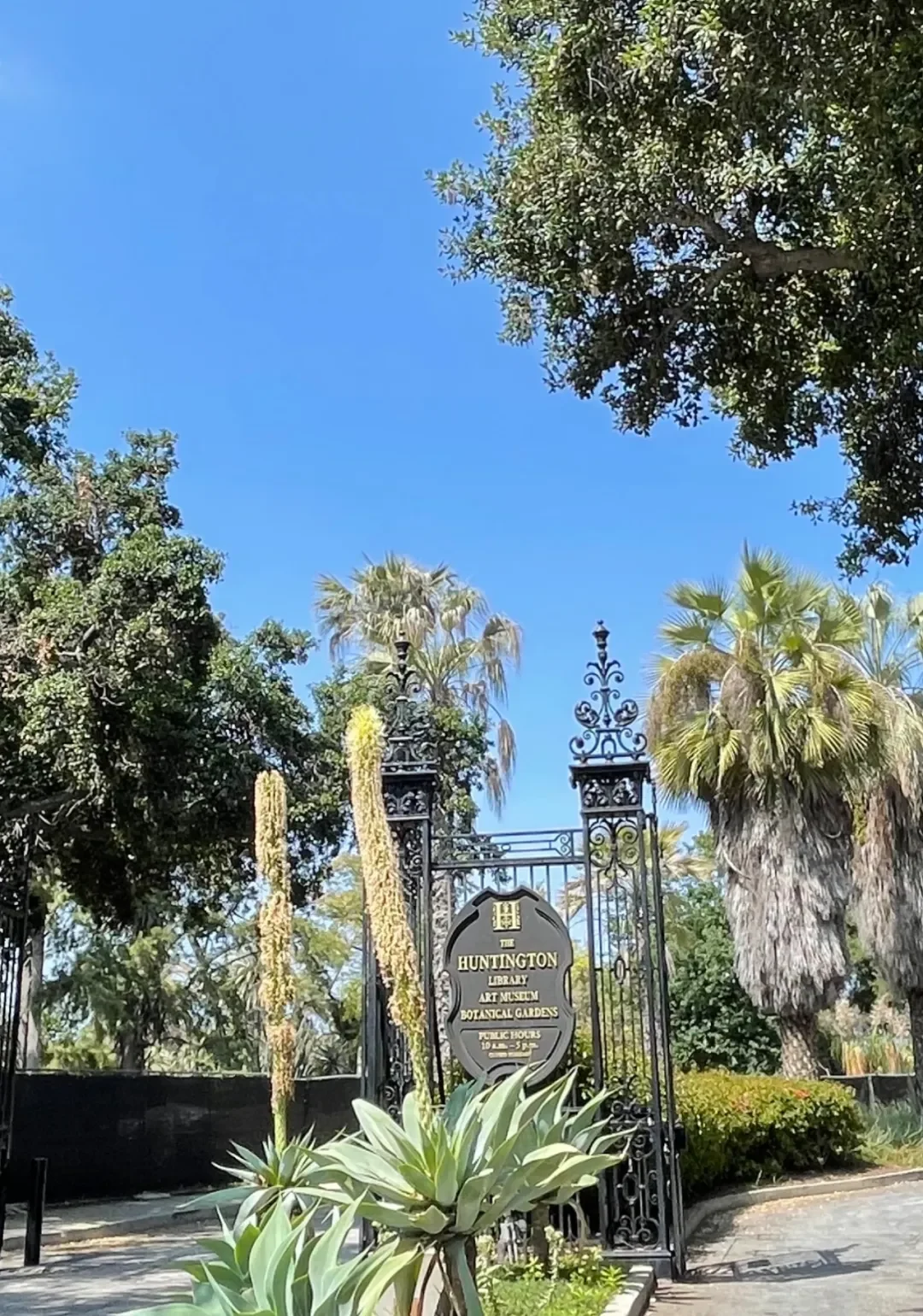
Photograph by Mingyue Gao, 12 May 2023.
Described as one of the world’s most unforgettable libraries set in a garden, it stands in San Marino, north of Los Angeles, California. In this joint achievement of humanity and nature are rare books, manuscripts and artworks, together with distinctive botanical gardens. They have made the Huntington renowned in America and around the world, a cultural landmark of Los Angeles and a place much loved by local residents.
Photograph by Mingyue Gao, 12 May 2023.
The Huntington’s website gives the following account of its history:
Railroad and real-estate businessman Henry Edwards Huntington was born on 27 February 1850 in Oneonta, New York. Henry and his uncle Collis P. Huntington were leaders in building railroads across the country. In 1892, Henry moved to San Francisco to represent the family’s Pacific Coast interests. In 1902, two years after Collis’s death, he moved his headquarters to Los Angeles and began connecting, consolidating and expanding Southern California’s streetcar system, the “Red Cars”. He held extensive land and business interests in the region. In 1903 he purchased the San Marino Ranch, now the Huntington Library, Art Collections and Botanical Gardens. In 1913 he married Collis’s widow, Arabella Duval Huntington.
Together they assembled extensive library, art and botanical collections that continue to grow. In August 1919 they signed a trust document transforming their private estate into a public institution, making the collections available for public welfare. Henry died in 1927, Arabella three years earlier. The Huntington opened to the public in 1928 and over the following century became an internationally recognised, collections-based nonprofit institution supporting the humanities, arts and botanical sciences. It seeks to be a welcoming place for everyone, embracing diversity among staff, visitors, curators and scholars, and working with diverse global communities to preserve, develop and share its collections.
Photograph by Mingyue Gao, 12 May 2023.
With its exceptional books, artworks and gardens, the Huntington is wonderfully inclusive in its interests and exquisite in its presentation. It merits a second visit, a third, and more.
A flower-covered walkway in the Rose Garden:
Photograph by Mingyue Gao, 12 May 2023. A corner of the Chinese Garden, Liu Fang Yuan:
Photograph by Mingyue Gao, 12 May 2023.
One sentence in the website’s introduction particularly caught my attention. Its original English reads: “In August of 1919, they signed a trust document that transformed their private estate into a public institution, making their collections available ‘to promote the public welfare.’”
Photograph by Mingyue Gao, 12 May 2023.
Photograph by Mingyue Gao, 12 May 2023.
In other words, they gave their personal property during their lifetimes to establish a charitable institution for public benefit. China, too, advocates common prosperity, which should encompass spiritual as well as material abundance. Cultural commentator Zhu Junbo has spoken of the charitable legacies of three wealthy Americans: the museums of oil magnate Paul Getty, the railroad-building Huntingtons and newspaper magnate Hearst. They directly embody the idea that enjoyment shared is better than enjoyment alone. I have now visited two; Hearst remains on my list for the near future.
Photograph by Mingyue Gao, 12 May 2023.
In my view, China already has many wealthy philanthropists; Lu Guanqiu, He Xiangjian and Cao Dewang are excellent examples. Yet museums of this quality, devoted to art and culture, with sound governance and broad public benefit, remain few. The reasons include technical shortcomings—imperfect systems for trust-property registration and taxation—as well as differences in public awareness of philanthropy. Chinese philanthropy still has a long road ahead.
The photograph above was taken at the Huntington’s entrance. As the next image shows clearly, it records the names of thirty-one former trustees since 1919, seven serving trustees and ten honorary trustees. The weight of a century of history rose from deep within me. Art and philanthropy can indeed shine enduringly through the passage of time.
Thinking of our own 1919, China was experiencing the May Fourth Movement and had only just begun calling for “Mr Democracy” and “Mr Science”…