English translation of the original personal essay; historical observations, figures and legal discussion reflect its publication date. Some photographs were not embedded in the supplied PDF; available images and the original captions are retained.
I rose early and cooked noodles with tomato and beef brisket left over from dinner with Professor Zhu the night before. After breakfast, I left Yale and hurried to New Haven station for a train to New York, where I was to meet Professor Li for Chengdu hotpot in Manhattan that evening. The train was slow, rather like Shanghai’s light rail, swaying along for over an hour before arriving at Grand Central.
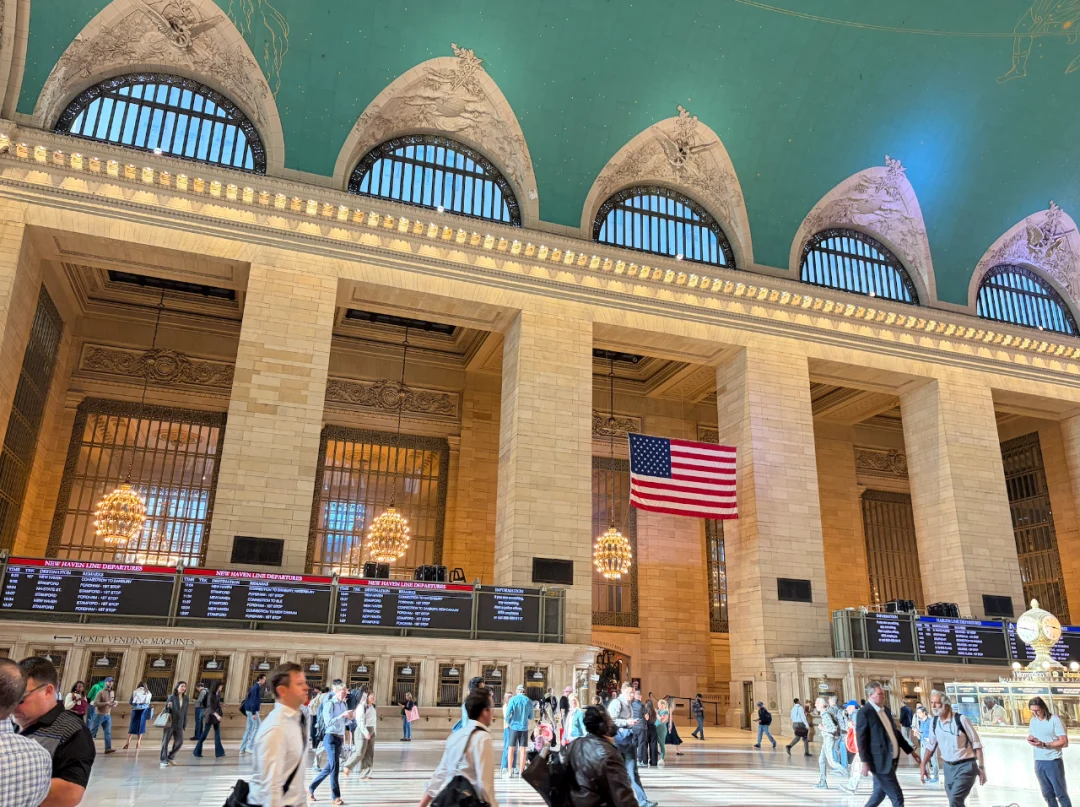
Grand Central. Photograph by Mingyue Gao.
Although dinner was in the evening, I had arrived early to visit the Metropolitan Museum of Art. My annual membership meant no online booking was needed, but at the entrance security told me it was closed on Wednesdays—and today was Wednesday. Then I remembered Zhu Junbo mentioning the Guggenheim nearby. Google Maps showed a ten-minute walk. Disappointment turned to delight, and I set off immediately.
The Met in the morning sun. Photograph by Mingyue Gao.
The Solomon R. Guggenheim Museum also stands on Fifth Avenue on Manhattan’s Upper East Side. One of the world’s most influential modern and contemporary art museums, it is a New York cultural landmark. Founded by industrialist and collector Solomon R. Guggenheim, it promotes non-objective and avant-garde art. Its main building, completed in 1959 and designed by Frank Lloyd Wright, is famous for its white spiral exterior. The building is itself a masterpiece and a National Historic Landmark.
Guggenheim Museum. Photograph by Mingyue Gao.
Its collection spans the late nineteenth century to the present, encompassing European Impressionism, Post-Impressionism, Cubism and Futurism, alongside American Abstract Expressionism and contemporary work. The permanent Thannhauser Collection is especially notable, bringing together Degas, Manet, Cézanne, Van Gogh, Monet and a particularly rich group of Picassos. The museum also regularly stages major international exhibitions exploring new artistic directions.
Picasso’s Le Moulin de la Galette. Photograph by Mingyue Gao. Picasso’s Woman Ironing. Photograph by Mingyue Gao. Picasso’s Fernande with a Black Mantilla. Photograph by Mingyue Gao.
Wright replaced conventional floors with a continuously rising spiral ramp, allowing visitors to view works as they walked gently upwards. It was a pioneering integration of architecture and the visitor’s route. Natural light enters through the enormous glass dome above, enlivening the atmosphere around the artworks.
Guggenheim Museum. Photograph by Mingyue Gao.
The Guggenheim is both a home for art and a platform for cultural exchange, part of an international network with sister institutions such as the Guggenheim Bilbao. Combining innovative architecture, adventurous curating and world-class collections, it is an essential stop for visitors exploring New York’s art and modernist spirit.
Guggenheim Museum. Photograph by Mingyue Gao.
My visit coincided with Rashid Johnson: A Poem for Deep Thinkers. Johnson, born in Chicago in 1977, sees people as products of their times, yet his art is especially interested in how individuals transform within powerful historical currents—and may even free themselves from their influence.
Guggenheim Museum. Photograph by Mingyue Gao.
For almost three decades Johnson has experimented with language, materials and form to question established twenty-first-century beliefs. He was deeply shaped by radical artistic and political movements from the 1960s to the 1990s, through both his parents’ activism and his education, when idealists challenged hierarchies and created new social norms. Keenly aware that those movements failed to create a truly just world, he nevertheless looks to wider history and personal experience to make powerful works about lives moving with their times and finding distinctive paths through history.
Guggenheim Museum. Photograph by Mingyue Gao.
A Poem for Deep Thinkers presents more than ninety works, tracing the artist’s development and aspirations. His early experimental photography, video and sculpture explore historical figures and events through humour and role-playing. Over time he developed a personal symbolic vocabulary and signature materials, including black soap and shea butter, incorporating them into mixed-media, three-dimensional still lifes and layered paintings.
Guggenheim Museum. Photograph by Mingyue Gao.
Cracked wooden panels, scarred bronze and ceramic sculptures, and deeply marked canvases express human vulnerability. Johnson also designed a performance stage on the ground floor for public participation, and a music space with an upright piano on the top level, adding new interactive dimensions.
Guggenheim Museum. Photograph by Mingyue Gao.
The exhibition reveals his willingness to abandon established styles and experiment with ideas, materials and subjects. Two things remain constant: his love of language and literature—the title comes from a poem by Amiri Baraka—and his pursuit of inner peace and creative fulfilment. Johnson often says, “My subject is freedom”, expressing his desire to move beyond the boundaries of art, culture and even time. With that inexhaustible drive, he finds poetry in daily life and gives ordinary things a heroic presence.
End.