English translation of the original personal essay; historical observations, figures and legal discussion reflect its publication date. Some photographs were not embedded in the supplied PDF; available images and the original captions are retained.
Mention Vincent van Gogh and many people immediately picture The Starry Night, Sunflowers and Irises. Today these celebrated paintings are dispersed among museums worldwide. Last month I visited the Van Gogh Museum in Amsterdam, a major centre for his work, with more than 1,400 items.
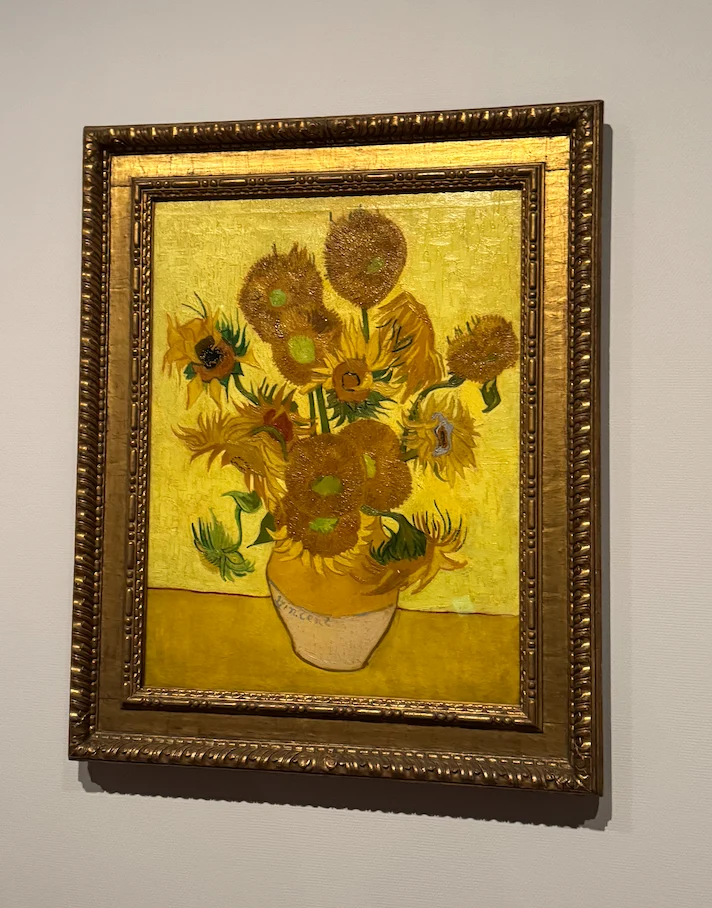
Sunflowers, 1889.
Photograph by Mingyue Gao, Van Gogh Museum, Amsterdam, 28 July 2025.
Outside the Netherlands, American museums also hold many of his works—around two hundred. So how did they acquire them? Did they buy them, or were they donated? Here is what I have gathered from my travels and observations.
1. America’s early encounter with Van Gogh
When Van Gogh died at the end of the nineteenth century, he was virtually unknown. His paintings attracted little interest even on the European market. Only in the early twentieth century, as Impressionism and Post-Impressionism gained recognition, did Americans begin to notice this extraordinary painter.
The Detroit Institute of Arts was the pioneering museum. In 1922 it purchased his Self-Portrait of 1887, becoming the first American public museum to buy a Van Gogh directly. The decision was controversial: the public had not yet fully embraced his brushwork and colour.
2. Purchases: a museum’s eye
Alongside Detroit, the Art Institute of Chicago began acquiring Van Gogh early. It owns a version of the famous Bedroom of 1889. By purchasing works for public collections, museums gave ordinary people their first opportunities to encounter him face to face.
Such direct acquisitions demonstrate institutional foresight. Early curators and directors took risks, committing limited funds to artists not yet widely recognised. Their decisions later proved remarkably prescient.
The Irises of 1889 shown below was purchased by the J. Paul Getty Museum in 1990. The price was about $53 million—more precisely, $53.9 million—making it one of the world’s most expensive paintings at the time.
Irises, 1889.
Photograph by Mingyue Gao, J. Paul Getty Museum, Los Angeles, 6 July 2019.
There is a twist to the story. In 1987 the Australian businessman Alan Bond caused a sensation by bidding $53.9 million for Irises at Sotheby’s. He later failed to pay the full amount, and the painting passed to a bank or financial institution. In 1990 the Getty purchased it for its permanent collection.
3. Gifts: private collectors’ generosity
By the mid-twentieth century, American art collecting had entered a golden age. Wealthy collectors and philanthropists turned towards modern art and donated works to public institutions.
At New York’s Museum of Modern Art, Van Gogh’s renowned Starry Night of 1889 entered the collection through collectors’ generosity. Early supporters included Lillie P. Bliss and Abby Aldrich Rockefeller. Without such private vision and generosity, the American public would not have had access to this astonishing night sky.
The Metropolitan Museum of Art holds several Van Goghs, including Irises and First Steps, after Millet, both from 1890 and received through private gifts. Adele R. Levy and George N. and Helen M. Richard were among those who donated their collections to the museum.
Irises, 1890.
Photograph by Mingyue Gao, Metropolitan Museum of Art, New York, 16 September 2025. First Steps, after Millet, 1890.
Photograph by Mingyue Gao, Metropolitan Museum of Art, New York, 16 September 2025.
Washington, DC’s Phillips Collection, America’s first museum of modern art, was founded by collector Duncan Phillips. He bought Van Gogh works with his own funds and later created a museum from his collection, effectively giving private artistic wealth to society. This recalls China’s Long Museum, founded by the noted collector Liu Yiqian and his wife from their personal collection, with Pudong and West Bund locations in Shanghai, among others.
Legally, the Metropolitan Museum of Art and Boston’s Museum of Fine Arts are nonprofit charitable corporations registered in their respective states and tax-exempt organisations under IRS section 501(c)(3). The Getty Museum differs: Paul Getty established a charitable trust through his will, also enjoying section 501(c)(3) status. The museum is one of its operating programmes, alongside the Getty Research Institute, Getty Conservation Institute and Getty Foundation. IRS tax registration deserves emphasis: tax incentives and policy guidance are important forces behind the flourishing of American philanthropy.
4. Bequests: art’s continuation
Alongside lifetime gifts, many works reach museums through bequests. Collectors leave them to public institutions in their wills, moving art from private ownership into public space. A notable example is the Rockefeller family foundation, among America’s most influential philanthropic forces, which helped MoMA and the Met expand their collections and provided more secure homes for Van Gogh’s work. The Night Café of 1888, shown below, was bequeathed to Yale University Art Gallery by the prominent American collector Stephen Carlton Clark.
The Night Café, 1888.
Photograph by Mingyue Gao, Yale University Art Gallery, New Haven, 14 September 2025.
China also offers examples of art and philanthropy working together. After Xu Beihong died, his wife Liao Jingwen followed his wishes by donating many of his works and collected objects to the state; Beijing later approved the establishment of the Xu Beihong Memorial Museum. Zhang Daqian, Wu Guanzhong and Liu Haisu provide other fine examples. Some artists’ succession arrangements, however, were less successful, with prolonged family disputes after their deaths, as in the cases of Li Keran, Lou Shibai, Xu Linlu and Zao Wou-Ki. There are many reasons; this cannot simply be blamed on a lack of charitable conviction. An important factor is the underdeveloped supporting framework for charitable giving. Tax arrangements for donations, including charitable trusts and foundations, remain incomplete. Tax relief for high-net-worth donors of property, including art, is insufficient, and substantial personal income tax may still arise. Trust-property registration systems have also not been established, leaving many obstacles to philanthropy through charitable trusts.
Wheat Field with Cypresses, 1889.
Photograph by Mingyue Gao, Metropolitan Museum of Art, New York, 16 September 2025.
5. Purchases and gifts together build public collections
The sources of Van Gogh works in American museums can be summarised as follows:
Direct museum purchases—bold early decisions demonstrating institutional foresight.
Lifetime gifts by private collectors—the large majority, reflecting an American tradition of public art collecting.
Private bequests—transforming personal wealth into public resources.
Today, whether we look up at The Starry Night at MoMA, admire the vitality of Irises at the Getty or confront the quiet, lonely, colour-charged Night Café at Yale, we seldom think about how these paintings travelled. Museum purchases and collectors’ generosity allow us to encounter a nineteenth-century Van Gogh in twenty-first-century America.
Roses, 1890.
Photograph by Mingyue Gao, Metropolitan Museum of Art, New York, 16 September 2025.
6. Art, philanthropy and social responsibility
This combination of purchases and donations also reflects the distinctive development of American museums. European collections often grew through royal or state power. American museums relied more on private initiative: wealthy individuals, collectors and philanthropists who brought art out of private drawing rooms and into public galleries.
As Zi Zhongyun writes in The Responsibility of Wealth, a society’s healthy development depends on maintaining a balance between wealth and responsibility. The journeys of Van Gogh’s paintings provide a revealing thread. Following them, we see not only changes in art history but also the maturation of American philanthropy and the force of public benefit and cultural responsibility it expresses.
Oleanders, 1888.
Photograph by Mingyue Gao, Metropolitan Museum of Art, New York, 16 September 2025.
End.