English translation of the original Chinese essay. Original Chinese illustrations are retained. English reading guide and web presentation updated: 7 October 2026.
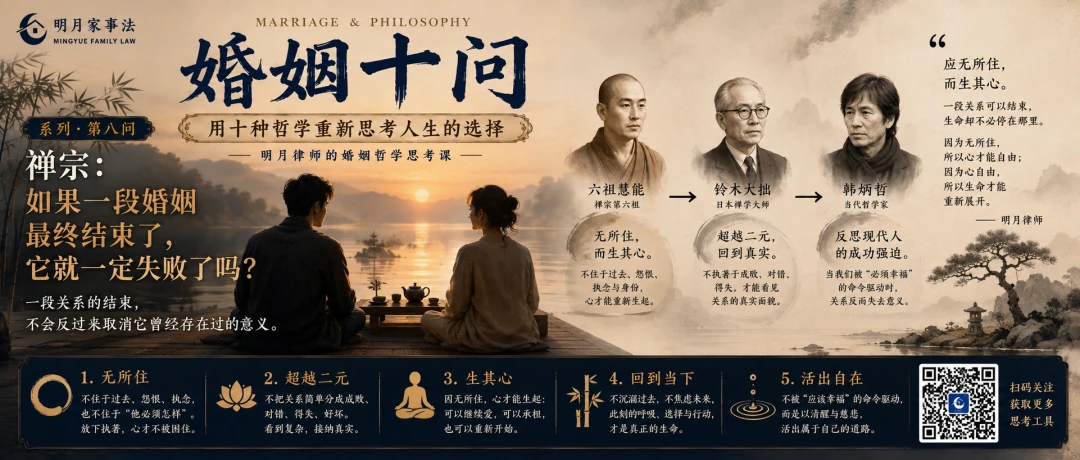
Many clients say something that has stayed with me:
“These twenty years have all been wasted.”
Sometimes their marriage has finally ended.
“We loved each other so much when we were young, yet we divorced in the end. What was the point of marrying?”
Sometimes they have experienced betrayal.
“After all those years devoted to this family, this is what I got. My life feels like a failure.”
Others divorced long ago, yet continually return to the past.
“I just cannot understand why he treated me like that.”
“If I had not married him, would my life be completely different?”
These seem to be recollections of a marriage. Beneath them lies a deeper question: if a marriage ultimately ends, has it necessarily failed?
This is our eighth question.
ENGLISH READING GUIDE
Zen
- An ending need not erase the value of what came before.
- Letting go emotionally does not mean abandoning legal rights.
- Make room for a life beyond a fixed account of the past.
A concise reading guide based on this essay; not a word-for-word translation of the original poster.
View the original Chinese learning poster
Across the first seven, we approached marriage from different perspectives.
Stoicism distinguished what we can control. Existentialism returned choice to us. Nietzsche explored self-creation after suffering. Plato considered love's direction. Buber asked us to encounter a whole “Thou”. Foucault revealed power, and Rawls prompted inquiry into fairness.
Yet when a relationship changes or ends, one question remains: how should we face a past we can no longer change?
Zen may open another way of understanding marriage.
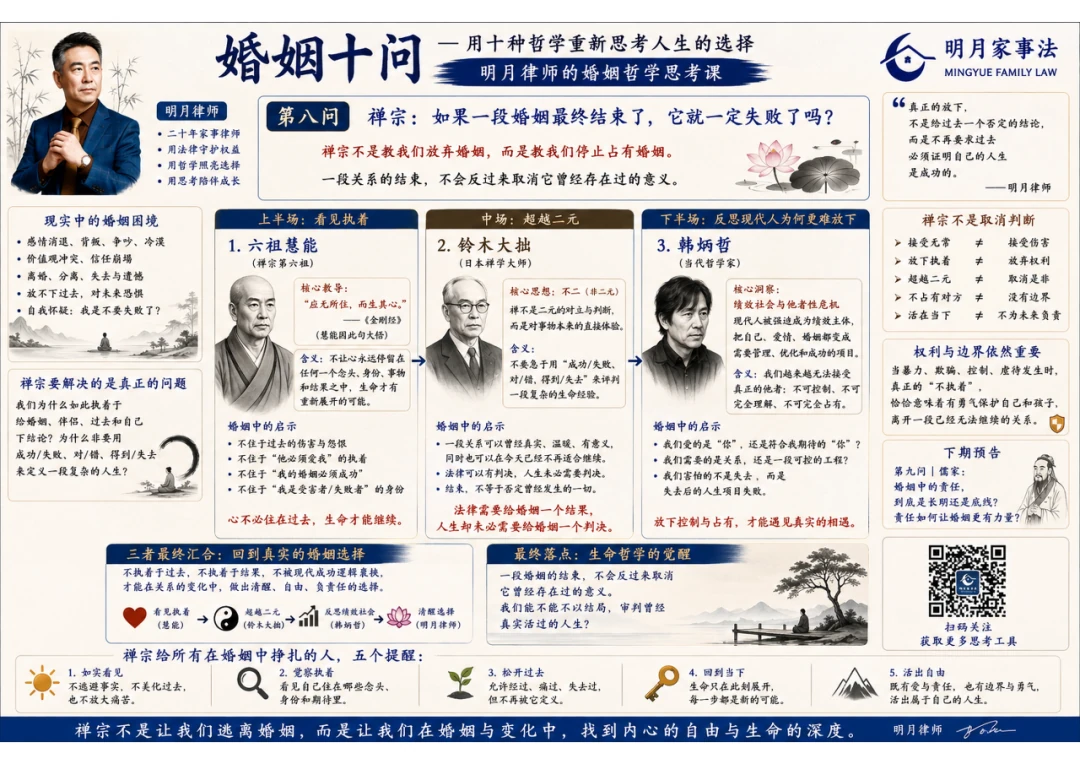
1. Let the mind arise without abiding anywhere
The Diamond Sutra contains a famous teaching: let the mind arise without abiding anywhere. The Platform Sutra records Huineng's great awakening when his teacher Hongren reached this passage. Non-abiding does not mean having no feelings, forgetting the past, or simply dismissing harm with “Never mind.”
It reminds us not to let the heart remain permanently fixed on a person, event or identity.
We can remember betrayal without spending the rest of our lives dwelling within it.
We can acknowledge that a marriage has ended without forever defining ourselves as someone whose marriage failed.
We can even continue to cherish memories.
The question is whether the past has fixed our lives in place.
Alongside non-abiding, the teaching asks the mind to arise. The point is not to let the heart die, but to allow life to grow again.
2. Why must a marriage be judged a success or a failure?
In explaining Zen to the modern world, the Japanese thinker D. T. Suzuki emphasised moving beyond dualistic distinctions. We habitually divide the world into success and failure, gain and loss, happiness and unhappiness, right and wrong.
We do the same with marriage. Growing old together counts as success; divorce readily becomes failure. Is real life so simple? A twenty-year marriage may contain genuine love, the joy of children's births, years of mutual support, and later arguments, disappointment or harm. Finally the couple separate. Was it a successful marriage or a failed one?
Perhaps the question itself is too simple.
A relationship ending later cannot retrospectively prove that everything before it was false.
Law must of course make judgments. Courts decide whether to dissolve a marriage, divide property, arrange children's care and allocate responsibility.
Life need not deliver the same kind of verdict.
The law needs an outcome for a marriage; life need not pass judgment on it.
3. Why are people today especially afraid of a failed marriage?
The contemporary philosopher Byung-Chul Han takes the question further. Modern society increasingly treats life as a project requiring continual optimisation. Careers must succeed, bodies must be managed, children must excel, and lives must be impressive. Even marriage becomes a success project.
We therefore want not only love, but love that proves our lives successful. When marriage ends, losing a partner can feel like receiving an enormous failing mark on life's report card.
Perhaps we should ask why marriage must prove anything at all.
More importantly, another person is genuinely other. They are not my creation. They will not always develop according to my expectations. They have thoughts, desires and choices of their own, including possibly leaving one day.
Perhaps love's real difficulty is whether I can love someone who does not wholly belong to me.
4. Letting go of attachment does not mean abandoning rights
A boundary must be clear. Zen is not advice to endure domestic violence, nor a message to someone betrayed that right and wrong do not matter and everything should simply be left to fate. Accepting impermanence does not mean accepting harm. Letting go of attachment does not mean giving up rights. Going beyond dualism does not erase moral distinctions.
A person can pursue property rights through law, protect children, refuse violence, seek accountability and firmly end a relationship that cannot continue.
What needs releasing is not boundaries, dignity or legal rights, but fixations on what cannot be changed that continue to occupy our lives.
Sometimes non-attachment means finally finding the courage to acknowledge that a relationship has ended.
5. Do not let the ending judge the life that was truly lived
This may be Zen's most important insight for marriage. We too often interpret life backwards from its ending. An unsuccessful career makes past effort seem pointless; love that did not last makes its beginnings seem mistaken; divorce makes decades of life seem a failure. But life is not a mathematics problem whose working matters only if the final answer is correct.
Some people accompany us for ten or twenty years before our paths diverge. That is certainly a source of sadness.
Yet an ending does not cancel what happened.
The years together, the genuine love, giving, growth and even suffering have become part of our lives.
When someone asks again,
“Were those twenty years wasted?”
perhaps Zen would not rush to answer.
It would simply remind us not to let the heart dwell there forever.
A relationship can end without life having to stop at that point.
Perhaps truly letting go means not condemning the past, but ceasing to demand that it prove one's life successful.
We need not use the final outcome to judge a life genuinely lived.
If a marriage ends, has it necessarily failed? Three questions from Mingyue Gao
Question 1
In a relationship that has changed or ended, what can I not let go of: the person, or the life I once expected?
Question 2
If I stop judging my marriage as successful or failed for a moment, how might I understand our years together differently?
Question 3
If one day I no longer let my heart dwell in the past, where would I want it to grow anew?