English translation of the original Chinese essay. Original Chinese illustrations are retained. English reading guide and web presentation updated: 7 October 2026.

In recent years, more women have asked me a question once seldom discussed publicly: “Why must I marry?”
They may not reject love, or even motherhood. But they hesitate: if marriage means having children, childbirth means interrupting a career, and care for children and elderly relatives falls mainly to them, will gaining a family mean gradually losing a career, income and the ability to choose their lives?
Some postpone marriage; some choose neither marriage nor children. Others consider preserving fertility and deciding later. Some ask whether marriage is the only path if they eventually want children.
These decisions have complex causes: economic pressures, housing, childcare costs, lifestyles and personal values. Yet another question deserves serious attention: if a person already anticipates structural inequality within marriage, why should she enter it?
This is our seventh question. Foucault showed how apparently personal choices may be shaped by wealth, gender roles, family responsibilities and social norms. Once we see those forces, a harder question follows: if two people do not begin from equal positions, how can they design fair rules?
ENGLISH READING GUIDE
Rawls and Okin
- Imagine the arrangement without knowing which role you would occupy.
- Apparent agreement can coexist with unequal choices.
- Consider how care, risk and opportunity are shared.
A concise reading guide based on this essay; not a word-for-word translation of the original poster.
View the original Chinese learning poster
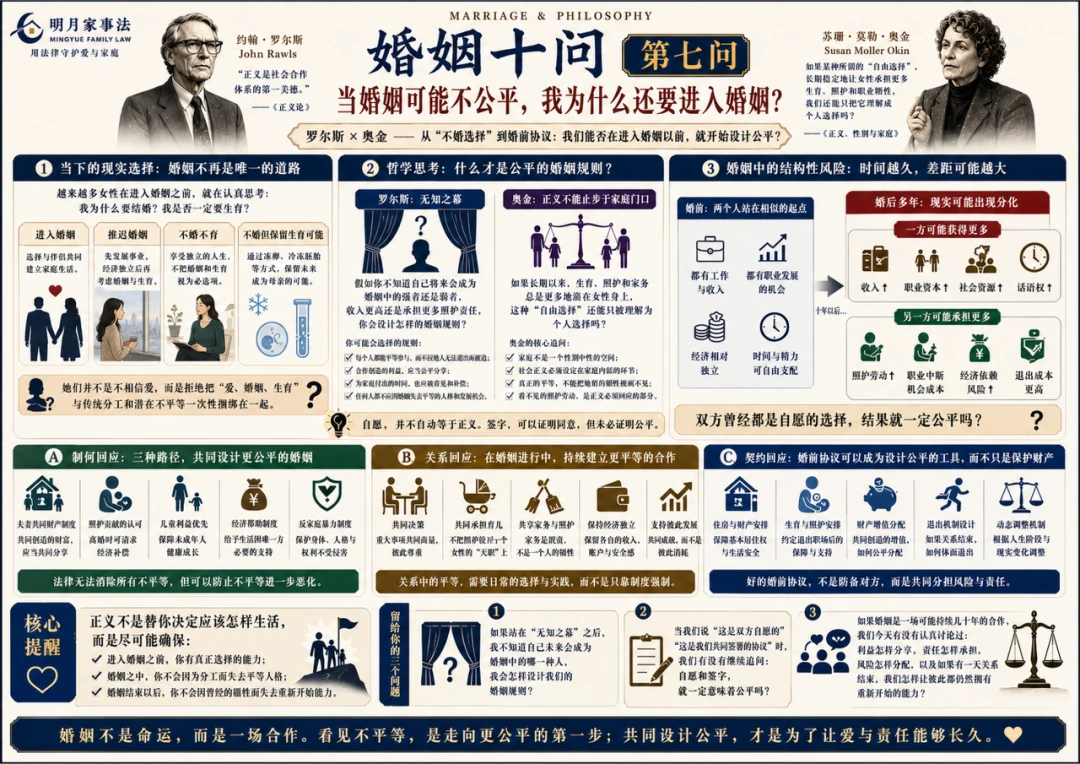
John Rawls and Susan Moller Okin may help us continue thinking.
1. If you did not know who you would become, would you still marry?
Rawls proposed the famous thought experiment of the veil of ignorance. Before designing social rules, imagine you do not know whether you will be rich or poor, strong or weak, or what your gender, abilities and social position will be. What rules would you choose?
We can place this veil before marriage. Imagine not knowing who will earn more, interrupt work for childbirth, do more housework and childcare, or care for both sets of parents. You do not know who will possess more career capital and social resources twenty years later, or who will most need protection if the marriage ends. Would you still design the same marital rules?
This is what makes Rawls so interesting. Fairness asks not what benefits me most from my present position, but whether I would still accept the rules if I became the more vulnerable person.
2. How can a voluntary arrangement still be unfair?
Okin raises a sharper question: why are women more often the ones reducing work, leaving employment and undertaking unpaid care for children? Many household divisions are entirely voluntary. The higher-earning husband continues working while the wife stays home after childbirth. At a particular moment, this may be the family's most rational arrangement. The problem is that time changes its consequences.
Ten years later, one person's income, career capital and social resources may have expanded while the other's career has been interrupted, earnings reduced, re-employment made difficult and economic dependence increased. A decision both initially accepted gradually produces structural inequality.
Saying “But you agreed at the time” may be insufficient. Okin asks why supposedly free choices follow gender lines so consistently.
This connects with Foucault. He asks who shaped the choosing self; Okin asks whether choices producing similar inequalities over time can still be understood as merely individual choices.
3. Perhaps this is why some young people are reconsidering marriage
We once routinely bundled love, marriage, childbirth and family together: love leads to marriage, marriage to children, and children to divided household roles. Increasingly, people examine these steps separately. Must I marry someone I love? Must I become a wife before a mother? Must wanting a family mean accepting traditional domestic roles?
Hesitation about marriage need not mean rejecting love. The deeper worry may be whether one can remain oneself within marriage. This poses a practical challenge to marriage as an institution: as alternatives expand, what does marriage itself offer that makes voluntary entry worthwhile?
4. Can we begin designing fairness before marrying?
This helps explain growing interest in prenuptial agreements. But such agreements can follow two very different logics.
One says: “Mine remains mine, yours remains yours.” Its main purpose is protecting existing premarital wealth.
Another asks what happens if one spouse interrupts a career for childbirth, undertakes more childcare and care work, or forgoes promotion and earnings for the family. If the marriage ends after twenty years, how can both retain the ability to start again?
The agreement then moves beyond protecting my property towards sharing the risks of marriage.
Yet a further question arises: does signing make it fair? If one person has substantial wealth, lawyers and advisers, while the other hears “No signature, no wedding” shortly before the ceremony, a signature may show consent without necessarily demonstrating fairness.
Perhaps a good prenuptial agreement is therefore not simply advance protection for the stronger party. It is an exercise in standing together behind a veil of ignorance and asking: if I someday bear more of the family's costs, what rules would I wish we had made today?
5. Justice in marriage should not begin only at divorce
Viewed this way, marital community property, compensation for domestic work, financial assistance on divorce and protection of children's interests address more than dividing money at separation. They confront a deeper question: how should contributions across decades of marital cooperation be recognised when wages and market prices cannot measure them?
Law can solve only part of this. A fair marriage also requires cooperation: shared childcare and care work, respect for both careers, and sufficient economic independence and ability to leave for each person.
From Foucault to Rawls and Okin, our thinking advances. Foucault asks us to see the forces shaping choice. Rawls asks for rules we would accept even as the vulnerable party. Okin reminds us that justice cannot stop at the family door. Justice does not choose whether you marry, work, care for children or become a particular kind of spouse. It should protect real choice before marriage, equal personhood despite domestic roles during it, and the ability to begin again afterwards despite sacrifices made for the family.
The final question may therefore be less “Is marriage fair?” than this: knowing that marriage can generate inequality, can we begin designing fairness together before entering it?
If marriage may be unfair, why enter it? Three questions from Mingyue Gao
Question 1
Before marrying, if I did not know whether I would earn more or carry more care responsibilities, how would I design our marital rules?
Question 2
When we say an arrangement is voluntary or jointly signed, do we go on to ask whether willingness and consent necessarily mean fairness?
Question 3
If marriage is cooperation lasting decades, have we seriously discussed beforehand how benefits, responsibilities and risks will be shared, and how each of us will retain the ability to choose our life anew?