English translation of the original Chinese essay. Original Chinese illustrations are retained. English reading guide and web presentation updated: 7 October 2026.
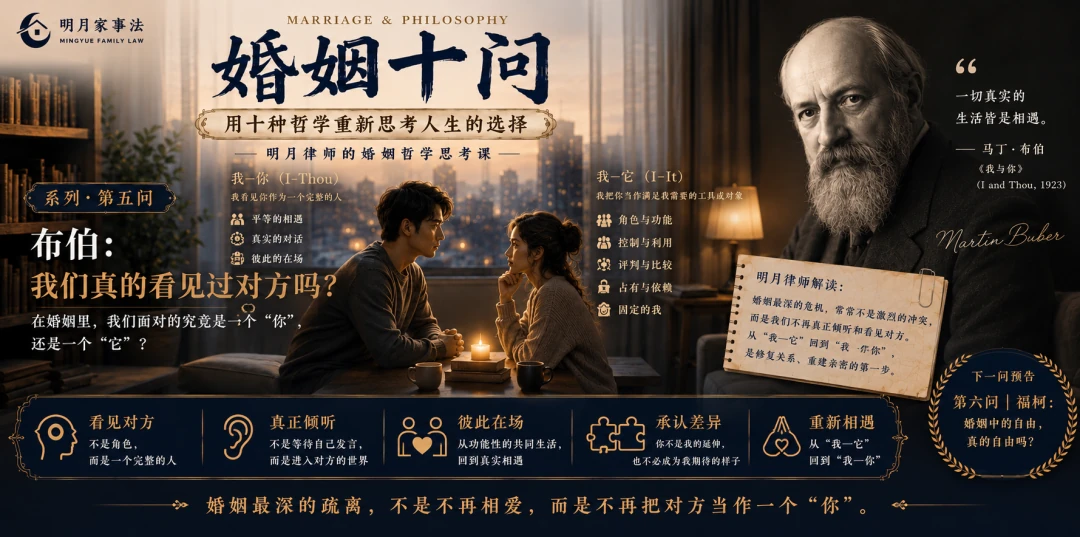
Many clients enter my office and repeatedly describe their partner's faults.
“He does not care about me at all.”
“She does nothing but make demands.”
“In this family, I am just a money-making tool.”
“All these years, everything I do has simply been taken for granted.”
“We live together every day, yet it has been a long time since we really talked.”
Some marriages have experienced no dramatic event: no domestic violence, no affair and no major property dispute. The couple still share a roof, meals, childcare and household responsibilities.
Yet they say: “We are becoming more like business partners.”
This brings us to our fifth question. The first four moved our thinking forward step by step. Stoicism distinguished what we can control. Existentialism reminded us that nobody can choose for us. Nietzsche explored recreating ourselves after suffering. With Plato, we reconsidered love: perhaps the important question is not who our true love is, but how we love.
Still another question remains: even if I believe I love you, have I really seen you?
ENGLISH READING GUIDE
Martin Buber
- Meet the other person as a person, not a function.
- Notice when expectations turn a partner into a means to an end.
- Dialogue can change how both people understand themselves.
A concise reading guide based on this essay; not a word-for-word translation of the original poster.
View the original Chinese learning poster
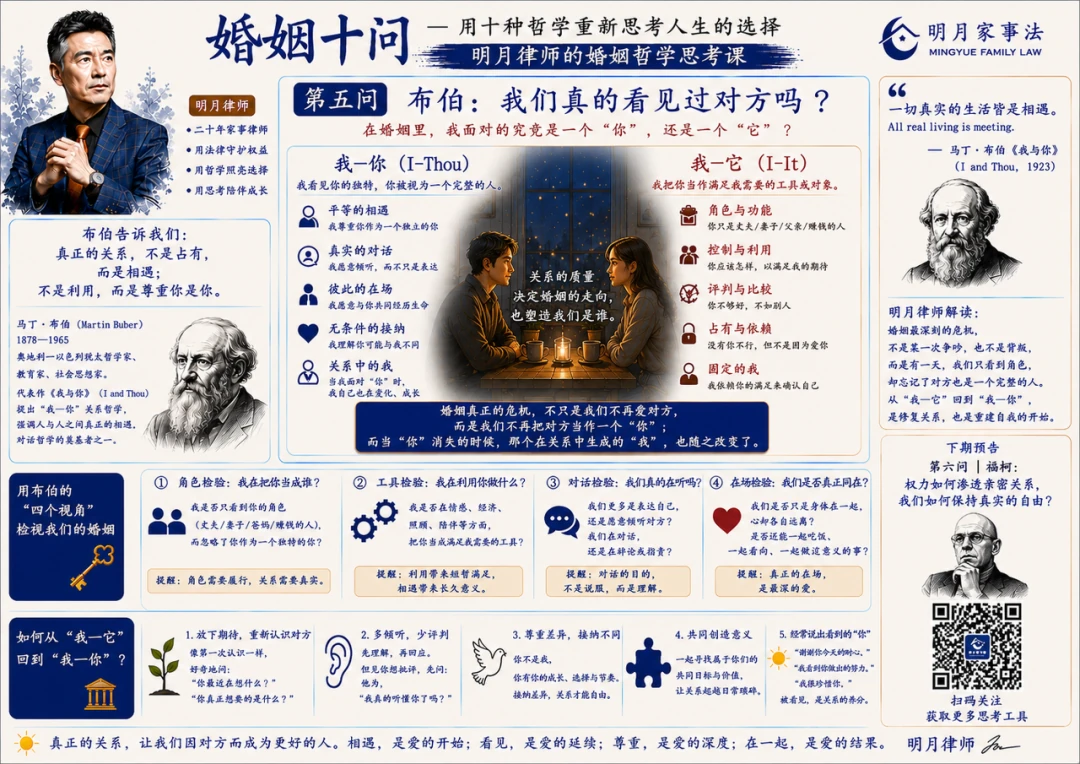
In I and Thou, the twentieth-century philosopher Martin Buber made a crucial distinction:
“I–Thou” and “I–It”. These terms may help us understand how marriages change.
1. Even a person can become an “It” to us
“I–It” does not mean the other person is literally an object. One of Buber's deepest insights is precisely that we can treat a living person as an object.
It happens daily in marriage. A husband becomes the breadwinner; a wife becomes the childcare provider. A spouse becomes a source of emotional support. Even a child may become a means of maintaining the marriage, fulfilling expectations or proving that one's life is successful.
We increasingly ask: “Why have you not done it?” “What responsibilities should you bear?” “How much do you earn each month?” “What else can you contribute to this family?”
Such questions are not meaningless. Shared life necessarily involves duties, divided labour and interests. The danger is that one day these are the only questions left. We see the husband but not the man, the wife but not the woman. We see a role and forget the whole person behind it.
2. What is “I–Thou”?
“I–Thou” is different. Facing a “Thou”, I no longer merely analyse, judge, demand from or use you. I acknowledge that you are as independent and whole as I am, and cannot be completely defined by me.
A genuine encounter therefore does not mean “You have finally become what I wanted.” It means “Even when you differ from my expectations, I still want to understand who you are.”
This is difficult in marriage. The closer someone is, the more readily we assume we know them. After ten years, we may predict their next sentence. Yet familiarity is not the same as seeing. Sometimes familiarity itself stops us listening carefully. We encounter an established image in our minds, rather than the person before us today.
3. In many marriages, love has not vanished; the “Thou” has
I often hear: “There are no feelings left between us.”
When did that absence begin? There may be no clear date. More often, the couple initially listened carefully to each other.
Later, conversation became logistics: “Have you collected the children?” “Has the mortgage been paid?” “When will you be home tomorrow?” Logistics became demands, demands became accusations, and accusations became silence. Eventually, they still lived together, but increasingly as two people performing functions for each other.
A marriage's deepest crisis is sometimes not a fierce argument, but the loss of curiosity about who the other person is. The “Thou” gradually disappears. Only husband, wife, father and mother remain.
4. When the “Thou” disappears, the “I” changes too
Here Buber may reach beyond ordinary relationship psychology. He does not merely advise respect for a partner. He asks how our relationships shape us.
When I continually treat you as a tool, role or object, more changes than your place in my eyes. I change as well, becoming increasingly accustomed to control, calculation, comparison and taking.
Conversely, when I truly encounter a “Thou”, listening, understanding and acknowledging difference, I may become more open and whole myself.
Marriage therefore invites us to ask not only “What has my partner become?” but also “Who have I become in this relationship?”
5. From Plato to Buber: love must rise, but also see the person before us
In the previous essay, Plato helped us ask where love should ultimately lead.
Plato takes love from desire and possession towards soul, virtue, wisdom, beauty and goodness. Buber raises an equally important question: before looking towards that distant destination, have you truly seen the person travelling beside you?
We readily fall in love with an ideal of marriage: what an ideal husband or wife should be, and what a happy family should look like.
As we cling more tightly to these standards, however, the particular person before us may gradually disappear.
Mature love may therefore mean more than finding someone who meets our expectations. It may mean being able to face an independent person and say: I know you do not exist to complete my life. I am willing to know you anew.
Buber famously writes in I and Thou that all real living is meeting.
Marriage may be one of life's longest and most difficult encounters.
The question is not merely whether we still live together. It is whether, after all these years, we can still encounter one another as a “Thou”.
Have we truly seen each other? Three questions from Mingyue Gao
Question 1
Looking at my partner, do I first see a husband, wife, or my children's parent—or the particular, changing person behind those roles?
Question 2
How long has it been since I genuinely asked, with curiosity, “What has been on your mind lately?” rather than “Why have you still not done this properly?”
Question 3
Am I trying to reshape my partner to meet my expectations, or am I still willing to acknowledge an independent “Thou” beyond myself?