English translation of the original Chinese essay. Original Chinese illustrations are retained. English reading guide and web presentation updated: 7 October 2026.
Many clients bring me a question more complicated than whether to divorce.
Their marriage has developed cracks, and a new relationship has appeared. This other person understands and appreciates them more, reviving an excitement they have not felt for years. They ask: “Is this person I have now met my true love?”
“If I no longer have feelings for my spouse, but feel powerful love for someone else, does that mean my marriage was a mistake from the start?”
“One person has been with me for years; another has made me feel alive again. Which one is my true love?”
This is the fourth of our Ten Questions on Marriage. The first three focused on ourselves. Stoicism helped us distinguish what we can control. Existentialism reminded us that nobody can choose for us. Nietzsche showed how we may recreate ourselves after suffering.
When we turn back towards love, however, a harder question arises: why do I love a person at all?
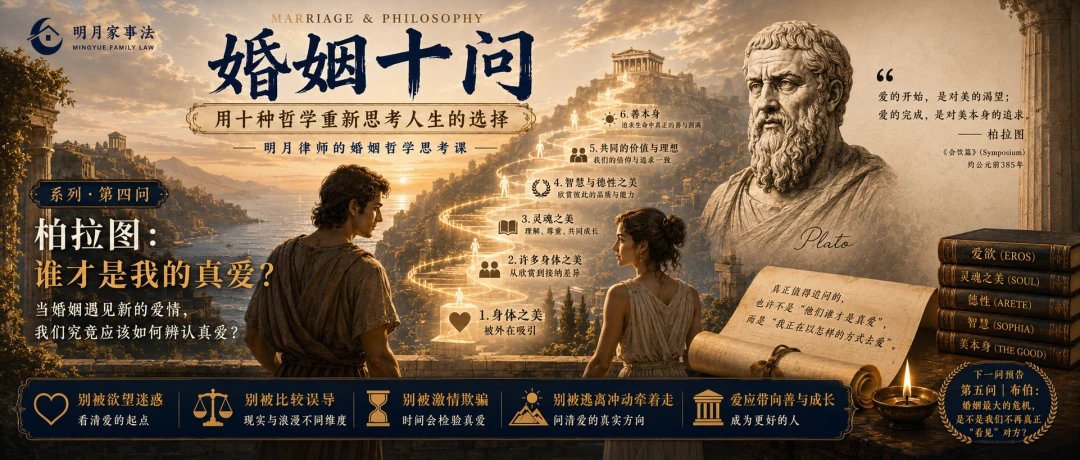
More than two thousand years ago, Plato explored this question profoundly in the Symposium.
ENGLISH READING GUIDE
Plato
- Attraction and a sustained shared life raise different questions.
- Do not compare a whole relationship with idealised fragments.
- Consider whether love supports each person’s development.
A concise reading guide based on this essay; not a word-for-word translation of the original poster.
View the original Chinese learning poster

1. Intense attraction does not necessarily equal true love
It is easy to understand love as a feeling: longing, excitement, sexual attraction, attachment, being understood and appreciated. These feelings are certainly real.
But Plato reminds us that eros often arises from a lack.
We are often drawn to someone because we see in them something we desire but currently lack. Someone long misunderstood in marriage meets a person willing to listen carefully. Someone surrounded daily by family obligations meets a person who restores a sense of freedom and attractiveness. Someone long overlooked feels appreciated and needed again.
A powerful feeling follows: “This is the real me.” “This person truly understands me.”
Yet we need to ask further: do I love this person, or the long-lost version of myself that they enable me to experience again? The two are not identical.
When someone says, “I have finally found true love,”
Plato might first ask: what exactly do you love?
2. We often compare two ways of living, not two people
A spouse and a new relationship outside marriage are often not being compared under the same conditions. Marriage carries the whole of reality: children, elderly parents, mortgages, housework, illness, work pressure, finances and the conflicts of living together over time.
Early new love, by contrast, often offers selected moments: conversations, dates, understanding, appreciation, travel, passion and novelty.
It is easy to conclude: “Only with her do I feel relaxed.” “Only with him am I happy.”
But what are we comparing: two people, or a complete life and a collection of romantic moments? Someone who has shared ten years of daily reality and someone not yet tested by everyday necessities cannot easily be compared on a single scale.
New love may be real. The intensity of passion alone does not prove that it is more “true” than a longstanding relationship.
3. Plato's crucial idea is the ladder of love
One of the Symposium's most famous ideas is the ladder of love. Love may begin with attraction to a particular body. As it develops, it may move towards appreciation of the soul, character and virtue, the pursuit of knowledge and wisdom, recognition of shared values, and ultimately beauty and goodness.
This does not simply mean bodily love is inferior and spiritual love superior. The important point is that love is not static: it needs to develop. When young, we may first love someone's looks, bearing, body and mystery. Within marriage, the questions gradually change: do I still admire this person's character?
Do we still share values? Can we still grow together?
As we face life together, are we helping one another become more mature, free and whole?
Passion fading therefore does not necessarily mean love has died. Sometimes only its former shape has ended. The question is whether it has continued to grow.
4. The soulmate can become a dangerous myth
The Symposium contains a famous story told by Aristophanes: human beings were once whole, then split in two, and each spends a lifetime searching for the missing half. It is deeply romantic. Taken as an absolute truth about modern marriage, however, it can be dangerous.
Once we believe there must be someone perfectly matched to us, differences, conflict and disappointment become easy to explain: “I found the wrong person.” We keep searching for the person who will supposedly complete us.
Perhaps the more mature question is not who can complete me, but whether I can become a more complete person and live alongside another whole person. Another person is not there to fill every absence in us. Love does not mean outsourcing our completeness.
5. Perhaps “Who is my true love?” is the wrong question
When someone painfully compares a spouse with another lover, the usual question is “Whom do I love more?” Plato might take that question a step further.
What deserves examination is not which person is the true love,
but how I am loving.
Do I love a real person or my own projection? Do I love them, or their ability to meet my needs? When passion subsides, will I still offer understanding, respect and responsibility?
Does this relationship make me more honest, courageous, free and whole, or require increasing concealment, lies, avoidance and inner division?
If love ultimately points towards goodness, a relationship must be judged not only by its excitement, but also by where it takes us.
6. What matters may be who this love is making me
The most useful insight in Plato's philosophy of love today may not be a recommendation to choose a spouse or a new lover. Philosophy cannot make that concrete choice for anyone. It can help rebuild our standards of judgment. Love worth cherishing need not remain passionately intense forever, but it should bring us closer to a more authentic, mature self with a greater capacity to love.
When asking “Who is my true love?”, perhaps we should also ask: if this relationship continues, who will I be in five years?
Marriage may never have meant simply finding someone who always makes us happy. More importantly, can we help each other become better people through a shared life?
Plato reminds us that love is not possession; it is an upward movement.
Mature love asks not only “What can you give me?” but increasingly “Where can we go together?”
Who is my true love? Three questions from Mingyue Gao
Question 1
When I say I have fallen in love with someone else, do I love this particular person, or a version of myself that they enable me to feel again?
Question 2
If I temporarily remove passion, novelty and the impulse to escape reality, how much understanding, respect, shared value and capacity for everyday life remain between us?
Question 3
Whether I ultimately stay or leave, is this relationship making me more honest, free and whole, or increasingly dependent on concealment, avoidance and inner division?