English translation of the full Chinese essay.
After a certain age, we become sensitive to things we would scarcely have noticed when we were young.
The first grey hair.
The first time the person in a photograph no longer quite matches the person in our memory.
The first late night that takes two or three days to recover from.
The first funeral of someone our own age.
The first medical report with an increasing number of arrows marking abnormal results.
Or the day a young person quite naturally calls us “Uncle”.
Each incident seems small in isolation.
Yet sometimes it leaves a subtle tremor inside: so I really am beginning to grow old.
We start exercising, watching what we eat, colouring our hair, having cosmetic treatments and taking all kinds of supplements.
There is, of course, nothing wrong with these efforts. But I have long felt that behind them lies a question worth thinking about more deeply: why are we afraid of growing old?
Is it really only wrinkles, grey hair and physical decline that we fear? Or is something more profound hidden behind ageing?
This is the first of the Ten Questions on Life that I want to explore.
1. First, we fear that our bodies will no longer fully obey us
When we are young, we rarely notice our bodies. We stay up late or travel far whenever we wish. After working for a dozen hours, a night’s sleep seems to restore us. The body feels like a tool that naturally belongs to us. With age, however, we discover its limits. Stamina declines, recovery slows, vision changes, memory sometimes falters, and medical reports raise questions we had never considered.
For the first time, we truly realise that the body will not always be under our command. The first anxiety of ageing is therefore a diminishing sense of control. In the past, wanting to do something was often enough. In the future, we may want to do it but find that our body will not allow it.
Yet fear of physical decline does not reach ageing’s deepest concern. Something more unsettling remains: when my body changes, am I still the person I was?
2. Why does the person in the mirror look less and less like the person within?
In her later years, the French philosopher Simone de Beauvoir wrote an important book, The Coming of Age. She explored an intriguing question: often we do not first recognise that we are old from within, but through the gaze of others.
This is a deeply recognisable experience. A sixty-year-old does not necessarily feel like “a sixty-year-old” every day. They may still remember the dreams of twenty, the struggles of thirty and the choices of forty. Deep within, the self has a powerful continuity. Yet the outside world keeps reminding them that they are no longer who they used to be. The face in the mirror changes. The person in photographs changes. Younger people speak to them differently. Their standing at work may shift. The identity society assigns them begins to change too.
A curious split appears: inwardly, I still seem to be myself; in other people’s eyes, I have become someone else.
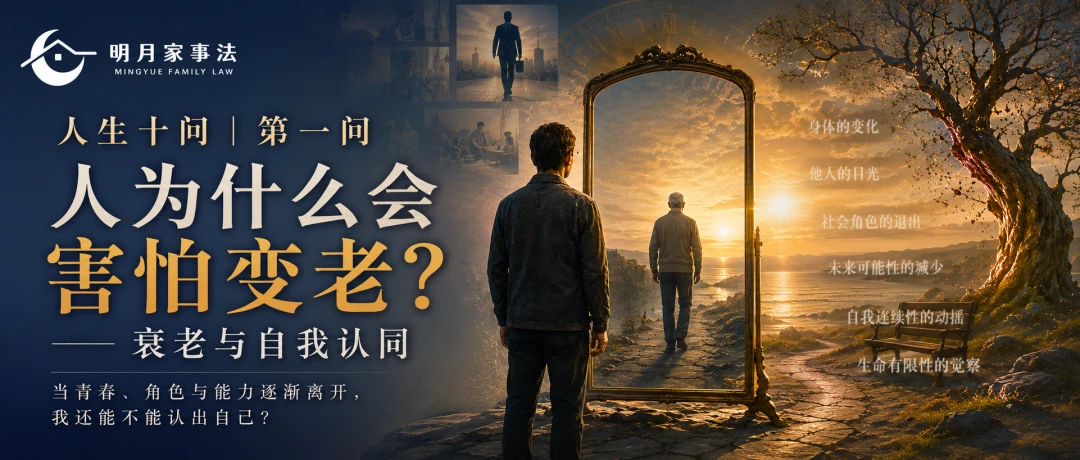
That is why I placed a mirror at the centre of the illustration above. Outside it stands the present self; within it is the older self. What I really want to ask is: is the person in the mirror still me?
For me, this is where ageing becomes a philosophical question. We are confronting not merely a physical problem, but a question of identity.
3. What if one day I lose the things that tell me who I am?
When we are young, we often introduce ourselves through roles: I am a lawyer, an entrepreneur, a professor, the head of a company. I am a husband, wife, father or mother. We rarely notice that these identities all help answer one question: who am I?
Ageing gradually loosens those identities. One day we will retire. One day we will no longer hold our position. Our children will grow up and need us less. The team that once relied so heavily on us will have a new leader. Even the professional skills, memory and judgement of which we are proud may eventually begin to decline.
Then a harsh but unavoidable question arises: if I am no longer “Lawyer Gao”, “Professor Wang” or “Director Li”, who am I? If we have defined ourselves throughout life by position, wealth, ability, appearance and others’ approval, ageing becomes frightening, because it steadily strips away precisely those external identities.
The American social gerontologist Robert Atchley proposed an important idea: continuity theory. As people age, they try to maintain both internal and external continuity. Put simply, although my body, roles and way of life have changed, I still want to know that I remain myself. The real question is therefore not how to prevent all change, but how to remain myself within it.
4. Perhaps ageing changes our understanding of remaining time more than our age
Stanford psychologist Laura Carstensen developed an illuminating idea called socioemotional selectivity theory. It suggests that what changes people is often not age itself, but how they understand the time they have left. When young, we naturally feel that the future stretches far ahead. We want to explore possibilities, meet more people, go to more places, learn more and seek more opportunities. Our guiding question is: what else can I gain?
As we grow older, we become more clearly aware that time is finite, and our priorities shift. We may no longer want to attend every dinner, maintain every relationship or spend so much time pursuing success as others define it. Instead, we value the people who truly matter, give greater weight to emotional quality and increasingly ask: what deserves the life I have left?
From this perspective, ageing is not entirely about loss. It can bring a capacity that is difficult to acquire when young: the ability to order our priorities. Youth offers more possibilities; maturity may mean finally knowing which possibilities do not really matter.
5. Do we fear ageing, or society’s definition of an old person?
Another question is often overlooked. Why do we instinctively see youth as good and old age as bad? Youth is associated with beauty, energy, love, creativity, competitiveness and the future. Old age is often portrayed as frailty, illness, conservatism, being out of touch, loneliness or even a burden. Sociology and ageing studies call this ageism. A society that continually presents youth as desirable also presents ageing as something to resist. More troublingly, we internalise these judgements. Before actually losing an ability, someone may already doubt it because of their age. Before society excludes them, they tell themselves: “I’m old.” “That’s no longer for me.” “I should stay out of young people’s affairs.”
I increasingly feel that sometimes we do not fear ageing itself. We fear the script for “old people” that society has already written for us. We must therefore ask: is age limiting me, or have I accepted someone else’s definition of that age?
6. At the deepest level, ageing confronts us with death
If we keep asking, we eventually reach a subject modern people are often reluctant to discuss: death. Why can a single grey hair suddenly make us feel a sense of loss? Why does the death of someone our own age affect us far more than an ordinary news story? Because these events remind us that time is not unlimited.
When young, we know rationally that everyone dies. But that is knowledge. With age, death slowly shifts from knowledge into experience. Parents grow older, people around us fall ill, peers occasionally die, and our own bodies change. For the first time, death moves from a remote philosophical concept into our own field of experience.
Born in the 1980s and already with nearly half my hair grey, I like to understand grey hair this way: it is less ageing itself than a notice sent from the future, reminding us that our time is limited. Must a limit be bad? Not necessarily. Precisely because life is finite, we must choose. Because we cannot pursue every possibility, we must decide what truly matters. If life were infinite and there were no difference between doing something today or a hundred years from now, many choices would lose their meaning. Awareness of death does not necessarily destroy life’s meaning. It may, for the first time, truly create it.
7. The second half of life may ask us to subtract rather than keep adding
The psychologist Erik Erikson described an important developmental task of later life as ego integrity. I find this concept compelling. It does not mean telling ourselves that our lives have been perfect or that we have never chosen wrongly.
True integrity means recognising our mistakes, the relationships we mishandled and the opportunities we missed; knowing we might choose differently if given another chance; and still being able to say: this is my life, and I accept it. When young, we tend to define ourselves by addition: another qualification, another position, more wealth, more connections, more success. We keep asking what else we can have. In life’s second half, perhaps we need to learn subtraction. Positions disappear, appearances change, children grow up, parents die, and wealth cannot ultimately be taken with us. Even the abilities we prize most may decline. What remains is an exposed question: if all these things are removed one by one, what is left?
Perhaps a truly mature identity is one that can still answer at that moment: I am left with myself.
8. Perhaps our real preparation is not learning how to avoid ageing
Looking back at the illustration, what I ultimately want to convey goes beyond six fears of ageing: changes in the body, the gaze of others, withdrawal from social roles, fewer future possibilities, a shaken sense of personal continuity and awareness of life’s limits.
On the surface, these are six different problems. Ultimately, they point to one question: as youth, roles and abilities gradually fall away, will I still recognise myself? Perhaps this is what we truly need to prepare for. Of course we should continue exercising, caring for our health, working and learning, sustaining physical and mental vitality for as long as possible.
But another preparation matters equally: gradually building a self that does not depend entirely on external identities. Knowing what truly matters to us, which relationships to cherish and what we can now let go. Knowing that even if we one day lose our present position, abilities and social standing, we retain our dignity and worth as human beings.
Perhaps life’s difficult question has never been “How much longer can I stay young?” but “How will I become myself when I am no longer young?”
If one day we stand before the mirror, look at our fully grey-haired selves and can calmly say, “I know you. I know what you have been through. This is my life, and I accept it,” ageing may cease to be only a process of losing things. It may become a different kind of fulfilment. What we ultimately need to preserve is not youth, but our ability to remain ourselves after time has taken things away.
Why are we afraid of growing old? I leave you with a question: if youth, position, wealth, ability and others’ approval gradually leave you, what will you use to answer—“Who am I?”