English translation of the Chinese original. Original illustrations are retained, including text within images. Translation and web presentation: 7 October 2026.
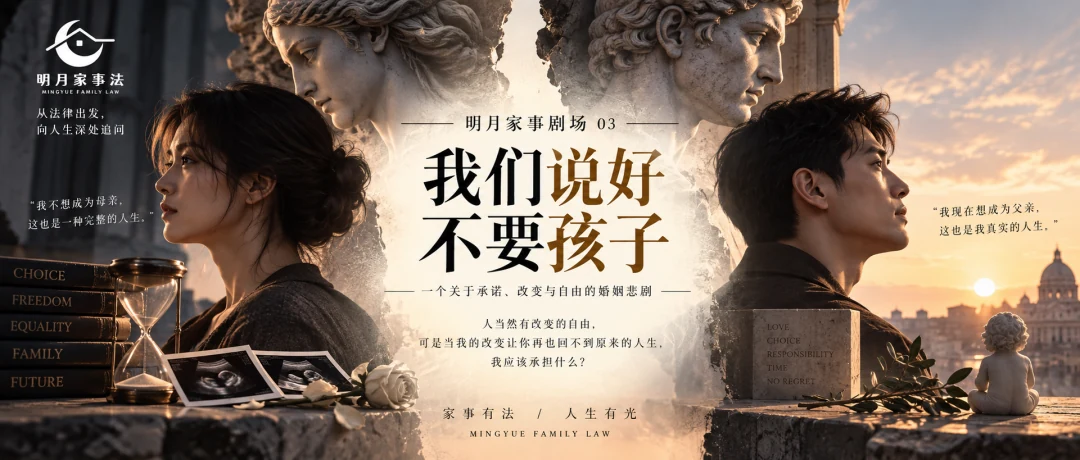
We Agreed Not to Have Children
A marriage tragedy of promises, change and freedom
Mingyue Gao’s note: An agreement can record a promise. But can it require our future selves to remain forever faithful to who we are today?
Act I: We Put Our Future in Writing
Zhou Xu and Xu Zhiyao had been married twelve years. Most who knew them thought it a good marriage: no affairs, violence or battles with in-laws, scarcely even arguments. They had careers and a shared life: travel, films, caring for both sets of parents, and a cat.
Unlike many couples, they had no children. Not because they could not, or were not ready, but because before marrying they had deliberately decided against it.
When Zhiyao was twenty-nine, they began discussing marriage: a home, parents, property, work—and children.
“There is something I must tell you before we marry. I don’t want children.”
Zhou Xu asked: “Not now, or not ever?”
“Not ever.” She was serious. “I like children, but I don’t want to be a mother.”
He was quiet for a while. “Actually, I feel the same.”
“Are you sure?”
“Sure.”
Because both had premarital assets, they asked a lawyer to draft a prenuptial agreement. Beyond property, the lawyer encouraged them to discuss the questions that truly mattered to their marriage, including having children.
They included this passage: “After full and careful discussion, both parties jointly choose not to have children after marriage and regard their life together as a couple as an important foundation of family life. Both confirm that this choice expresses their genuine and independent wishes.”
On signing day, Zhiyao joked: “At last, we’ve settled the big questions.”
Zhou Xu laughed. “Now we won’t have to discuss it again.”
They signed the final page.
Zhou Xu.
Xu Zhiyao.
That year, both believed they knew the lives they wanted.
Act II: Leaving a Door Open
In their second year of marriage, when Zhiyao was thirty-one, a doctor asked after a check-up whether she planned to have children. She said no.
The doctor mentioned fertility preservation if she wished to retain future possibilities. She told Zhou Xu at home.
He thought. “Should we look into it?”
“Into what?”
“Freezing eggs.”
“Or… preserving embryos.”
She was surprised. “Didn’t we agree not to have children?”
“Yes.”
“Then why?”
He thought again. “I still don’t want them. But life is long. What if we change?”
She looked at him. “So?”
“Leave our future selves a choice.”
She was silent, then shook her head. “If we’ve decided against children, why put my body through medical procedures for a life we don’t want?”
“I only wanted to leave a way back.”
She smiled. “If every decision needs an escape route because we fear regret, have we really decided anything?”
He did not insist. “Then we won’t.”
They never raised it again.
They continued living the life they had chosen together.
One year.
Five years.
Ten years.
Twelve years.
Act III: I Have Changed
At forty-two, Zhou Xu’s father went into hospital for a relatively minor operation.
One day, while he sat beside him, the daughter of the patient next door brought a five- or six-year-old child to visit. The child leaned over the bed, chattering to Grandpa.
His father watched, then asked: “Who will visit you when you’re old?”
Zhou Xu smiled. “Zhiyao.”
His father smiled too. “And when she’s old?”
Zhou Xu did not answer.
His father said no more.
But the question stayed.
For the next six months, he noticed things he had never noticed: friends’ photographs of their children, children learning to cycle, colleagues complaining about school runs, babies crying on planes.
For the first time, he seriously asked himself: What if I had a child? At first he felt ashamed. They had agreed otherwise. They had even written it down.
So he stayed silent for six months.
Then one evening after his forty-second birthday, he said after dinner: “Zhiyao.”
“Yes?”
“There’s something I want to discuss.”
She looked up.
After a long silence: “I want a child.”
She thought she had misheard. “What?”
“I want to be a father.”
“What did your dad say to you?”
“It isn’t because of him.”
“Then why?”
“I don’t know.”
“I’ve been thinking for six months.”
“I’ve simply realised…” A long pause. “I’ve changed.”
She stared at him. “What does that mean?”
“Twelve years ago, I meant it when I said I didn’t want children. I didn’t lie. I signed that agreement myself; every word was genuine. But now—” He looked at her. “Wanting a child now is genuine too.”
She said nothing for a long time. Then only: “But we agreed.”
Act IV: What You Changed Was an Idea
At first, Zhiyao did not see a marriage crisis. She thought it was midlife anxiety: his father’s illness, friends becoming parents, getting older, death becoming imaginable.
She was willing to listen.
They talked intermittently for two months.
Until he said: “Could we seriously consider it?”
“Consider what?”
“Having a child.”
She looked at him. “How?”
He was startled. “What do you mean?”
“I’m forty-one. What exactly does ‘we’ll have a child’ mean? Who becomes pregnant? Who bears the physical risks? Who gives birth? Whose career may be interrupted? And whom will society expect to do more of the care?”
“I can do more. We can hire help. I could even work less.”
She shook her head. “You can share raising a child. You cannot be pregnant for me. Zhou Xu, you have changed an idea. You are asking me to change my body and the rest of my life.”
He said nothing more.
A week later: “All right. I respect your decision.”
She thought it was over.
Then he said: “So I want a divorce.”
Act V: What About My Life?
She stared at him. “Because I won’t give you a child?”
“No.”
“Then why?”
“Because you still don’t want to be a mother.”
“And now I want to be a father.”
She laughed bitterly. “What’s the difference?”
He lowered his head. “I don’t know how to say it without hurting you.”
“Then stop making it sound so noble.”
After a long silence, he said: “If I cannot ask you to become a mother for our marriage, can you ask me to give up fatherhood forever for it?”
She did not answer. She realised she could not easily refute him.
That was precisely what made it so cruel.
Act VI: In Black and White
Their first visit to my office was about divorce. No third party, hidden assets, domestic violence or even a substantive property dispute.
Zhiyao took a document from her bag: the twelve-year-old prenuptial agreement. Its paper had aged. She opened a page and pushed it towards me. “Look here, Mr Gao.”
I read: “After full and careful discussion, both parties jointly choose not to have children…” Their signatures were below.
“This wasn’t a casual remark. We consulted a lawyer, discussed it and wrote it down. He signed it. If he can just change his mind, what is this agreement worth?”
I put it on the desk. “This agreement matters.”
“So he breached it?”
I paused. “We need to separate the issues.”
“A prenuptial agreement is a legal document. But it cannot turn every aspect of life into a contract enforceable like a property sale. The Civil Code makes an important distinction: its contract provisions govern contractual relations; agreements concerning personal-status relationships such as marriage are governed first by the relevant status rules, rather than simply treated as commercial contracts.”
I pointed to the agreement. “Lawful arrangements for ownership of premarital and marital property can be binding. But having children is not an ordinary property obligation. It concerns the body, personhood and reproductive autonomy. You could certainly express a joint choice not to have children twelve years ago. This is strong evidence that you discussed it seriously and genuinely meant it. But it cannot mean that, because you signed then, you may never change your reproductive wishes after forty-two.”
“So this clause is invalid?”
I considered. “If interpreted as permanently prohibiting either party from changing reproductive choices, with a court compelled to enforce that personal-status promise, it cannot have that effect. A change of reproductive wishes cannot be treated like breach of a commercial contract requiring continued performance of ‘not having children’. The reverse is also true. A clause requiring two children does not let a husband compel pregnancy or childbirth. The Supreme People’s Court’s current interpretation states a clear position: a husband’s damages claim alleging that his wife’s autonomous termination of pregnancy infringed his reproductive rights will not be upheld. If fundamental disagreement over having children breaks down the marriage, the law addresses whether it should continue, not compulsion to have or not have children.”
After a silence, she asked: “So it’s useless?”
I shook my head. “Unenforceable is not the same as meaningless. It proves something important.” I looked at Zhou Xu. “Twelve years ago, he was not deceiving you.”
He looked up.
“And it proves you had reason to believe this was your shared plan for life. It cannot imprison today’s Zhou Xu, but it preserves who he was twelve years ago.”
The office fell quiet.
Act VII: The Words Have Not Changed; the People Have
Zhou Xu stared at his signature. Eventually: “I signed it. I don’t deny it. I wasn’t lying. If I returned to thirty, I think I would still sign.”
He paused. “But does a person have the right to contradict their past self?”
Zhiyao looked up. This time she did not say he had no right to change.
She said: “Yes.”
He was surprised.
“Of course you can change.” She slowly pushed the agreement back. “But why does your change give you freedom while leaving me to pay the price?”
He had no answer.
She pointed to his signature. “I’m not asking you to remain thirty forever. I want to know whether the forty-two-year-old you has any responsibility towards the thirty-year-old who signed this.”
This time, even the law could not answer for them.
Act VIII: What If We Had Preserved That Possibility?
Near the end, Zhou Xu suddenly said: “We did discuss freezing eggs.”
She glanced at him.
He added quickly: “I’m not blaming you. I sometimes wonder whether, if we had preserved embryos, we might at least have another option now.”
After a long silence: “So I failed to leave today’s you a way out?”
“No.”
“Then why did the me who did not want motherhood twelve years ago owe it to a possibly changed future you to preserve that possibility in advance?”
No one answered.
A few days later, Zhiyao went alone to hospital.
She had not decided to have a child. She simply wanted to know whether she still could, if she wished.
The doctor discussed age, physical condition, possibilities and risks.
Finally, calmly: “Of course it is different from ten years ago.”
On the metro home, she found old messages with Zhou Xu from twelve years earlier. He wrote: “Life is long. Perhaps we shouldn’t close every door to the future.”
Thirty-one-year-old Zhiyao replied: “Sometimes closing doors is how we know which path we’ve chosen.”
At forty-one, she stared at that sentence. For the first time, she did not know whether her younger self had been brave or too certain. She still did not know whether she regretted having no children.
What hurt most was not even the child never born. It was discovering that time had taken away choices once her own.
Act IX: What About My Twelve Years?
On their second visit, they had largely decided to divorce. Property was comparatively easy to settle.
Near the end, she asked: “Zhou Xu?”
“Yes?”
“If you had told me twelve years ago that you might change at forty-two, would I have married you?”
After silence: “I don’t know.”
“I do. Perhaps not. At thirty, other people wanted to be with me. One made clear he wanted children. I didn’t choose him. I chose you—not merely a man called Zhou Xu, but the life we agreed on.” She pointed to the agreement. “Of course you can change now. But I cannot live those twelve years again.”
He bowed his head. “I’m sorry.”
She shook her head. “I’m not asking for an apology. I want to know whether, after changing, a person still owes anything to someone who believed him.”
Act X: Can My Past Self Decide for Me Today?
At the end, she asked me: “If the law cannot make him honour this clause, what do promises mean?”
I did not answer immediately.
Zhou Xu spoke first. “And what about me?”
He looked at me.
“Does signing my name at thirty take away my right to become someone different at forty-two?”
It was the hardest question in the case.
The law can identify boundaries. It will not let a husband use an agreement to compel pregnancy. Nor will writing “no children” twelve years ago permanently remove his freedom to change his wishes. Some decisions about personhood and status must still belong to the person at the time they are made.
Where the law’s answer ends, life’s questions begin. Permission to change does not erase earlier promises. One person is free to choose a new life; another may truly have entrusted twelve irreversible years to their shared plan in reliance on that choice.
The conflict is therefore no longer merely whether an agreement is valid. It is how much responsibility today’s self bears for yesterday’s promises.
Act XI: Do You Still Love Me?
There was no argument when the divorce was completed. They left together. The lift arrived. Zhiyao entered; Zhou Xu remained outside.
Just before the doors closed, she pressed the open button. “Zhou Xu?”
“Yes?”
“Did you love me twelve years ago?”
He looked at her. “Yes.”
“And now?”
After a long time: “Still.”
“Then why have we ended up here?”
He did not answer.
The doors slowly closed.
I thought of the agreement signed twelve years earlier.
The names on paper had not changed: Zhou Xu, Xu Zhiyao.
The writing was the same.
The people were different.
Epilogue
As family lawyers, we help people plan: prenuptial and marital property agreements, wills, voluntary guardianship, advance healthcare directives, trusts. These tools matter. A thoughtful person should be able to arrange their life.
Yet the longer I practise, the more I see a variable no legal plan can eliminate: people change. We can agree on property, record values, discuss children and solemnly write down our genuine wishes. No agreement guarantees we will be the same people ten years later.
A good prenuptial agreement may therefore matter less for fixing a future than for making couples seriously discuss life-changing questions before marriage: children, fidelity, priorities between career and family, parents, property—and what happens if we change? If one day we are no longer who we are today, how will we treat each other?
Agreements record promises but cannot eliminate change. Law can manage risk but cannot remove life’s uncertainty.
The Law Behind the Story
A point in this story is easily misunderstood: if the couple expressly agreed not to have children, why can either later change their mind? The key is this:
A prenuptial agreement is not a commercial contract
Article 464 of the PRC Civil Code distinguishes ordinary contracts from agreements concerning personal-status relationships such as marriage. The relevant status rules apply first; only where they make no provision may contract rules be applied by reference, according to the agreement’s nature. The transactional logic of “you signed, so you must comply” cannot simply be transplanted.
Spouses may lawfully make written arrangements for premarital and marital property. Reproduction, however, is not property. It concerns the body, personhood, family life and fundamental choices. A “no children” clause cannot have the force of permanently removing reproductive autonomy or compelling continued childlessness through a court order because someone signed twelve years earlier.
The reverse also applies. A promise to have two children cannot compel pregnancy or childbirth or prohibit termination. Article 23 of the Supreme People’s Court’s Interpretation (I) on the Marriage and Family Book of the Civil Code states that a husband’s damages claim alleging that his wife’s termination of pregnancy without his consent violated his reproductive rights will not be upheld. If disagreement about children leads to an irretrievable breakdown, the law addresses whether the marriage continues, rather than forcing either reproductive choice.
The more accurate conclusion is not that the entire prenuptial agreement is invalid. Lawful property clauses may remain effective, while provisions seeking permanently to restrict reproductive autonomy or compel performance of a personal-status obligation of “no children” cannot have that binding effect.
That is why the agreement in this play still matters. It cannot bind Zhou Xu to his past self, but it shows Zhiyao’s reliance was grounded in a serious shared decision. Once the legal issue ends, a harder question emerges: the law may permit change, but how should someone who changes treat the person who arranged her life around that promise?
No judgment alone can answer that.
Questions Behind the Story
Twelve years ago, they wrote on one sheet: we do not want children. Twelve years later, she still chooses that life; he has changed. The law tells us an agreement cannot permanently surrender self-determination. Life asks further: if we are free to become another self, does today’s self remain responsible for yesterday’s promises? When change meets another person’s irreversible reliance, which should yield—freedom or commitment? Perhaps mature marriage planning is not an attempt to ensure we never change. It is having the courage, when most in love, to ask: what will we do if you change one day?