English translation of the original Chinese essay. Original Chinese illustrations are retained. English reading guide and web presentation updated: 7 October 2026.
What makes a marriage worth having?
From “I” to “You” to “We”, and finally towards a life worth living
When clients first enter my office, their questions are usually concrete.
“Should I continue this marriage?”
“Will he ever change?”
“If I divorce, will I regret it?”
“What about the children?”
“Is the person I have now met my true love?”
“Why do I feel less and less free, even though we are spouses?”
“After all these years of giving, why does it still feel unfair?”
I have heard these questions for many years. The longer I practise family law, the more I see that marital difficulties often reach beyond what law can directly answer. Law can explain spouses' rights and obligations, how property is divided on divorce, and arrangements for children. After violence, betrayal, deception or interference with property, it can also provide remedies.
But law struggles to answer how a person should live. That is why I began bringing philosophy into discussions of marriage—not because it supplies a standard answer. Its value often lies less in giving answers than in helping us ask deeper questions.
That is how these ten questions began.
We have now reached the last essay. This time I want to move beyond a particular marital difficulty and ask something larger: what makes a marriage truly worth having? We might go further: why enter marriage at all? If it is not solely for children, economic cooperation, companionship, or because society tells us to marry, where does its real meaning lie?
This question brings us to Aristotle.
Before turning to him, I would like to revisit the first nine questions. At this tenth stage, it becomes clearer that they are not isolated fragments of philosophical knowledge. They form a path: from “I”, towards “You”, and then towards “We”.
1. The first stage: facing ourselves
From “What is beyond my control?” to “Who do I want to become?” The first three questions concern Stoicism, existentialism and Nietzsche, yet all address the same issue: when life does not follow my wishes, how should I face myself?
Question One: Stoicism—accept that life is not entirely yours to command
Marriage's first pain often comes from a deep illusion: if I try hard enough, I can make another person live as I expect. If I am good to you, you should be good to me. If I give, you should repay. If I sacrifice for the family, you should not betray me. If I have changed, you should change too.
Marriage soon teaches us that another person is never an extension of our will. We cannot control their feelings, desires, fidelity or timing of change. We cannot even control whether a marriage ends as we hope. Stoicism therefore gives the series its starting point: distinguish what is within your control from what is not. We cannot control the world or another person, but we can still decide our judgments, actions, boundaries and choices.
This looks like a simple distinction. In fact, it marks the beginning of maturity: only when we stop insisting on controlling others do we truly return to ourselves. The next question follows naturally: if life cannot be fully controlled, how should I choose within marriage?
Question Two: Existentialism—freedom is difficult because the choice must be yours
This takes us to existentialism. What many clients most want from a lawyer is not legal advice but an answer: “Tell me whether I should divorce.” I cannot answer that for them. Neither can parents, friends, judges or philosophers.
Existentialism confronts us with an uncomfortable fact: no one can make the choice for us. Staying, leaving, waiting and following parents' advice are choices. Even postponing a decision is a choice. Sartre's description of being condemned to freedom captures its weight. Freedom does not simply mean doing whatever I want. It means that I must ultimately decide and bear the consequences.
The marital question changes. Instead of asking only what others would do, we ask who we want to become. Yet deciding does not end every problem. Sometimes the marriage has ended, judgment has been delivered, property divided and children's arrangements settled, but the person has still not moved on. What then?
Question Three: Nietzsche—even after fate has acted, you can reinterpret your life
This brings us to Nietzsche. After a marriage breaks down, the greatest danger is not merely sadness but interpreting a relationship's failure as the failure of an entire life. “Am I unworthy of love?” “Have I wasted all those years?” “Why me?” “Will I ever have a real life again?”
Nietzsche offers another perspective: what happens to us does not automatically determine its lifelong meaning. What matters is who we intend to become afterwards. The same suffering can destroy a person or become the beginning of self-understanding. The first three questions thus complete a cycle: Stoicism accepts what cannot be controlled; existentialism chooses within what can be decided; Nietzsche goes further—even if fate gives an unwanted answer, we may still recreate ourselves.
These first three essays build the inner person. Together they ask how I can become capable of facing life. Yet marriage is not a solitary discipline. When we turn from ourselves towards another person, the second stage begins.
2. The second stage: facing another person
From “Why do I love you?” to “Do I truly treat you as a person?” If the first three questions establish the “I”, Questions Four, Five and Six examine what happens when “I” encounter “You”.
Question Four: Plato—where does love take you?
Plato first asks us seriously what love is. When another lover enters a marriage, the question becomes acute. New passion, understanding, appreciation and novelty prompt the claim: “This person is my true love.” Plato reminds us that powerful desire does not automatically mean a higher form of love. The Symposium's ladder of love begins with bodily attraction, but mature love need not remain there. It can rise towards appreciation of the soul and from a particular person towards beauty, goodness and higher values.
The important question is not merely who excites me more, but where this love takes me. Does it make me possessive, narrow and dependent on desire, or richer, clearer and closer to goodness? We begin to see that love is more than a feeling; it can be a path of growth. Yet even genuine love carries a danger: loving someone without truly seeing them.
Question Five: Martin Buber—the greatest danger in intimacy is turning “You” into “It”
Buber distinguishes “I–Thou” from “I–It”. Applied to marriage, the distinction can sting. A couple may share decades of meals, childcare and property management, apparently closely connected, while one has ceased to recognise the other as a complete subject. A husband becomes a breadwinner, a wife a caregiver, a spouse an instrument of security, sex, status or emotional support. The marriage remains, but the genuine encounter disappears.
“I–Thou” does not require daily passion. It acknowledges another person as whole, like oneself: not property, a function or merely part of one's life plan. They have desires, fears, experiences, choices and a future of their own. If Plato asks why I love you, Buber asks whether I have really seen you. This is marriage's crucial movement from romance towards ethics.
Yet sharing a life inevitably raises another issue. Even with mutual respect, there are influence, domination, definitions and resource allocation. In other words, relationships always contain power.
Question Six: Foucault—power goes deepest when you manage yourself on its behalf
Foucault shows that power exists not only in governments, prisons and institutions, but in intimate relationships. Who decides how money is spent or children educated? Who may have an independent social life? Who checks whose phone? Who defines the good wife or responsible husband?
Power need not appear as an order. It may arrive gently as “It is for your own good.” Deeper still, it enters the mind. A person tells themselves that a good wife should sacrifice, men must not be weak, or children mean they have no right to leave. External discipline becomes self-discipline.
The second stage therefore forms a progression: Plato asks why I love you; Buber asks whether I recognise you as a subject; Foucault asks how power operates between us.
We finally recognise that marriage is not merely a love story. It is also a structure of shared life. Sharing life necessarily leads to the third stage: how should we live together?
3. The third stage: building a shared life
From fairness to letting go to responsibility, Questions Seven, Eight and Nine move beyond “I” and “You” to how we should construct a life together.
Question Seven: Rawls—beyond love, marriage must answer whether it is fair
Love matters, but marriage cannot consist of love alone. Living together raises questions of resources, opportunities, labour and sacrifice. Who leaves employment for childbirth, provides more care, controls family wealth, has career opportunities or has greater ability to leave?
Much inequality arises without anyone deliberately acting badly. Social structures, gender roles, economic capacity and longstanding bargaining differences can produce it. A good marriage therefore asks not only whether we love each other, but whether our arrangements are fair. Fairness is not simply a fifty-fifty split: identical formal treatment can widen substantive inequality. Rawls moves marriage from private feeling towards justice. Yet fairness alone does not automatically bring happiness. Even clearly allocated rights and duties can leave people suffering, partly because attachment remains.
Question Eight: Zen—maturity sometimes means releasing a question, not solving it
The first seven essays ask what to do: how to choose, act fairly, resist power and face hurt. With Zen we pause to ask whether every problem must be “solved”.
Much marital suffering comes not only from an unbearable reality, but from insisting that reality complete itself according to our imagined script: “They must apologise.” “My last ten years must be repaid.” “This marriage must prove that I chose correctly.” “I can be happy only when they become what I want.”
Zen reveals how the self that refuses to let go can trap us. Letting go is not surrender; non-abiding is not indifference. It is the capacity not to let one thought, relationship or injury occupy an entire life. This introduces an inner loosening into the series. But letting go alone risks another imbalance: if life becomes solely my own inner peace, what happens to children, promises and family responsibilities? Is being true to myself sufficient? This leads to Question Nine.
Question Nine: Confucianism—a mature person needs responsibility as well as freedom
Confucianism reminds us that we are never entirely isolated individuals. We are independent people, but also spouses, parents, children and family members. We live in relationships. Beyond love, freedom and fairness, marriage contains an unavoidable dimension: responsibility.
Modern emphasis on self-realisation is progress. But asking only whether I am happy, still feel love or still have my needs met can obscure another ethical question: what responsibility do I bear for our shared life, children, family and commitments? Responsibility never requires enduring violence, humiliation or endless self-sacrifice. Mature responsibility respects individual dignity while recognising that freedom is not all of life.
The third stage thus concludes: Rawls calls for fairness in shared life; Zen for letting go; Confucianism for responsibility.
The first nine questions are now complete: control, choice, rebuilding, love, encounter, power, fairness, letting go and responsibility. Yet a fundamental question remains. Why learn these things? Why restrain ourselves, choose, rebuild, act fairly or bear responsibility? Where do these efforts ultimately lead?
At last, the tenth question appears.
ENGLISH READING GUIDE
Aristotle
- A flourishing life takes shape through sustained practice.
- Consider friendship and character alongside attraction.
- Ask what kind of shared life the relationship makes possible.
A concise reading guide based on this essay; not a word-for-word translation of the original poster.
View the original Chinese learning poster
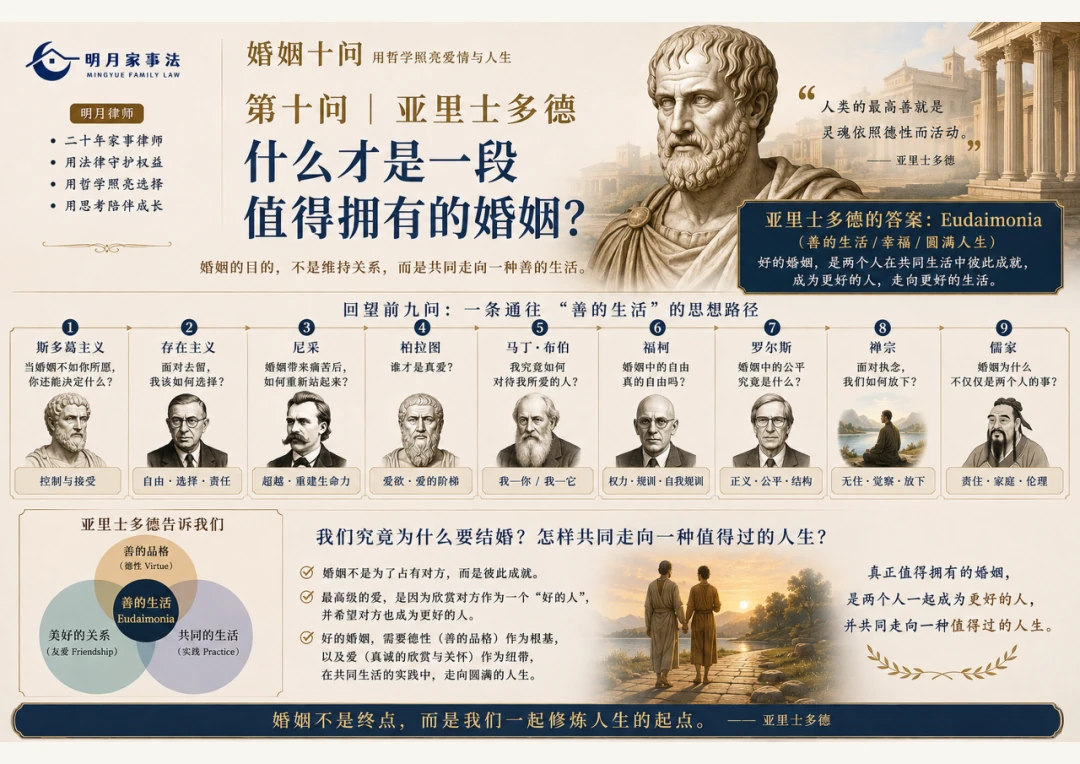
4. Aristotle: after nine questions, we ask about life's purpose
Aristotle's greatness lies in a simple, fundamental question: what are our actions ultimately for? Work aims at income; income at living; study at knowledge. Marriage may aim at love, companionship, children, family or security. Continue asking why we want these things, and eventually we reach a question behind which we cannot retreat: what kind of life do I want to live?
Aristotle calls the highest human good eudaimonia. Often translated as happiness, it is misunderstood if reduced to pleasure. It is not a passing psychological state, today's cheerfulness, or the satisfaction of wealth, reputation and comfort. It is closer to a life unfolding well.
In other words: have I lived fully as a person? Have my capacities developed and my character matured? Have I built relationships worth cherishing? Through action over a long life, am I becoming better? Aristotle asks not whether I feel good now, but who I am becoming across my life. This is the question our series must ultimately face.
5. Eudaimonia: happiness is living well, not merely feeling good
Today we readily judge marriage through feeling: “I feel nothing now.” “This marriage makes me unhappy.” “I am happier with someone else.”
Feelings are real and should not be dismissed. Aristotle nevertheless distinguishes pleasure from happiness. Many pleasures need not make a good life. Similarly, marriage may contain pain, setbacks, arguments, illness and duties. It will not always be pleasant, but that does not make it worthless.
Caring for an ill spouse may be exhausting. Raising children can involve anxiety and sacrifice. Long cohabitation requires adjustment and restraint. Yet if these experiences develop loyalty, courage, temperance, patience, justice and the capacity to love, they may form part of a good life in Aristotle's sense. The measure of marriage shifts from whether it makes me happy to who it makes me become.
6. Virtue: good marriage rests on practised character, not passion alone
Virtue is another core of Aristotle's ethics. It is not an abstract moral slogan, but stable character developed through sustained practice. A courageous person is not made by one brave act; repeated choices form the habit of courage.
The same applies to marriage. A wedding does not automatically make a good spouse. Many capacities develop only through living together: honesty, restraint, patience, generosity, loyalty, justice and responsibility; keeping proportion when angry, boundaries when tempted, limits when powerful, and respect when a partner is vulnerable. Love does not automatically give us these abilities at the beginning. They require practice.
From Aristotle's perspective, marriage is therefore not a static status but a long practice. Each day we answer what kind of partner—and, more deeply, what kind of person—we wish to become.
7. Philia: friendship may offer marriage more than romance alone
One of Aristotle's major discussions of relationships concerns philia, usually translated as friendship or affectionate friendship. He distinguishes relationships by their foundations.
The first rests on usefulness: I maintain a relationship because you are useful to me. Marriage certainly contains much such cooperation—income, care, housework, children and social resources.
The second rests on pleasure: I like you because your appearance, character, humour, body or companionship makes me happy. This too matters in love.
Aristotle regards friendship grounded in character as higher and more stable. I cherish you not simply for what you provide or the happiness of your company, but because I admire you as a person. I wish you well not only because your welfare benefits me, but because you deserve a good life. More importantly, I wish you to become better, as you wish the same for me.
The relationship changes fundamentally. It becomes shared growth rather than mere exchange. This seems especially valuable for lasting marriage. Young love often begins with “I feel good when I am with you.” Mature love may gradually become “Because we are together, we have both become better people.”
8. Shared practice: marriage is a life made together, not possession
This is a third reason Aristotle's thought suits marriage. A good life is not an abstract condition; it must be formed through practice. Marriage likewise cannot rely merely on declaring love.
What defines a marriage is how the couple live, talk, argue, spend, share responsibilities, educate children, relate to parents, face illness and ageing, handle temptation, and respond to their changing lives day after day. Marriage is not a certificate, nor only a promise. It is a shared practice, recreated daily. Yesterday's love does not automatically secure today's relationship. A promise ten years ago cannot replace action today.
A good marriage therefore needs good character, good relationships and good shared practice. All three meet in eudaimonia: a good life.
9. Aristotle brings the first nine questions together
Looking back, the series' intellectual path is now clear.
The first three ask how I become capable of facing life: Stoicism accepts limits, existentialism takes responsibility for choice, and Nietzsche rebuilds the self.
The middle three ask how I genuinely face another person: Plato understands love, Buber respects subjecthood, and Foucault remains alert to power.
The next three ask how we build a shared life: Rawls pursues fairness, Zen learns to let go, and Confucianism accepts responsibility.
Aristotle finally asks why we do all this. Because a good marriage should do more than preserve a relationship: it should help two independent people live better.
This is the real destination of Ten Questions on Marriage.
10. Marriage's purpose is not simply never to divorce
This invites reconsideration of a familiar assumption: the longer a marriage lasts, the more successful it is, while divorce means failure. Suppose a forty-year marriage contains persistent humiliation, control, coldness and suppression, maintained only through social pressure or economic necessity. Can duration alone make it a good marriage?
Conversely, if a relationship ends after years of sincere love and mutual growth, with a farewell conducted respectfully and responsibly, can we simply call it a failure?
We finally see that preserving marriage cannot itself be its highest purpose. What matters is who that shared life has made us.
11. What makes a marriage worth having?
After these ten questions, I offer an answer that is not absolute, but in which I increasingly believe. A worthwhile marriage is not conflict-free, endlessly passionate, or composed of two people who never change. Nor can it be judged solely by whether it lasts to the end. It may instead enable two independent people, over a long shared life, to see, respect, temper and help realise each other. It allows freedom without abandoning responsibility; acknowledges difference while pursuing fairness; permits intimacy without making another person a possession; and understands perseverance as well as the times when letting go is necessary.
Above all, sharing life helps both people gradually become better.
We need love, but also freedom; beyond freedom, justice; beyond justice, responsibility; and beyond responsibility, understanding, restraint and generosity. These converge not to prove to the world that our marriage succeeded, but towards a more important aim: making our lives richer.
Conclusion: marriage is a practice of life, not life's answer
When I began Ten Questions on Marriage, I wanted to discuss questions a lawyer finds hard to answer: whether to divorce, who is a true love, and what freedom, fairness and responsibility mean. By the end, I increasingly felt that marriage was never the only subject. Ultimately, the essays ask how a person should live.
We cannot control everything, but we can choose. Choice brings responsibility. After suffering, we can still recreate ourselves. We may love someone without making them a tool for our needs. Living in relationships requires alertness to power and a pursuit of fairness. We need perseverance and sometimes release. We possess freedom while also living within responsibilities.
All these questions flow into Aristotle's ancient question: what is a life worth living? Perhaps marriage's greatest meaning is not finding someone who will solve life for us. It is two independent people deciding to place part of their lives together: experiencing time, ageing, responsibility and change, while learning together how to love, be free, be fair, exercise restraint, let go and become better people.
To close the whole series in one thought: a marriage worth having is not simply two lonely people finally finding each other. It is two independent people helping each other flourish over a long shared life and moving together towards a life worth living. This may be Aristotle's eudaimonia, and the destination of these ten questions. Marriage is not an endpoint. It is a beginning for practising together how to live, love and become better people.
End

Guantao Law Firm, Shanghai
Address: 22F, L’Avenue, 99 Xianxia Road, Shanghai 200336, China
Address: 22F, L’Avenue, 99 Xianxia Road, Shanghai, PRC
Tel: +86 21 2356 3298
Fax: +86 21 2356 3299
Email: gaomy@guantao.com