English translation of the original Chinese essay. Original Chinese illustrations are retained. English reading guide and web presentation updated: 7 October 2026.
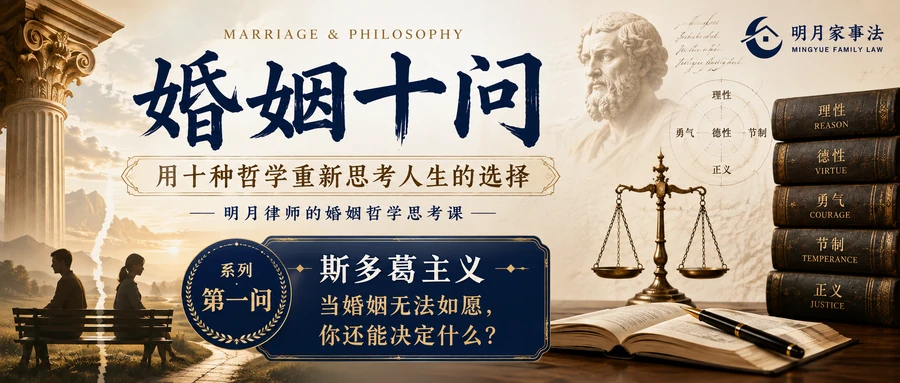
For many clients sitting across from me, the first question that truly hurts is not how property will be divided in a divorce. It is a question the law can scarcely answer: should I stay in this marriage, or leave?
“Will he ever change?” “What will happen to the children if we divorce?” “What will other people think?” “Will I regret leaving?” “If I hold on for a few more years, might everything get better?”
These questions cause pain because we long for certainty. Yet marriage is one of the areas of life least likely to offer a certain answer.
Stoicism, a philosophy more than two thousand years old, may offer a different way of thinking.
ENGLISH READING GUIDE
Stoicism
- Distinguish what you can influence from what you cannot.
- Acceptance does not require accepting mistreatment.
- Let considered values guide your response.
A concise reading guide based on this essay; not a word-for-word translation of the original poster.
View the original Chinese learning poster

1. Before asking whether to divorce, ask what you can decide
One central Stoic idea is commonly called the “dichotomy of control”.
At the beginning of the Enchiridion, the ancient Greek philosopher Epictetus tells us that some things depend on us and others do not.
The idea sounds simple, yet it has considerable force within a marriage.
You cannot control whether your spouse still loves you. You cannot change a betrayal that has already happened, or decide whether your spouse genuinely repents. Nor can you fully control how either family judges you, what friends think of your divorce, or even how your children will understand your decision many years later.
Other things, however, remain in your hands.
You can decide how to respond to hurt, whether to accept an apology, and how much time to allow a relationship to heal. You can establish boundaries. And when certain limits have been crossed again and again, you can decide whether to end the relationship.
When a marriage reaches a crisis, Stoicism therefore does not first demand an immediate decision to stay or leave. It asks us to draw two circles:
One contains what I can control; the other contains what I cannot.
Much of our suffering comes from repeatedly trying to control the second circle.
2. Accepting reality does not mean enduring everything
Some people misunderstand Stoicism as saying: “If you cannot change it, simply put up with it.”
Quite the opposite.
Stoicism asks us to accept what has already happened. It does not require us to accept every unjust relationship.
Accepting that someone betrayed you does not oblige you to forgive.
Accepting that they may never change does not oblige you to remain married.
What matters is not building your life around the uncontrollable assumption that one day they will change.
When you stop insisting on changing another person, you may recover the ability to decide your own life.
3. The deeper question is who you want to become
Beyond the dichotomy of control, Stoicism places even greater importance on virtue.
For the Stoics, what a person can truly possess is not wealth, marriage, or even another person's love, but their own character and choices.
The Stoic tradition particularly values four virtues:
Wisdom, courage, temperance and justice.
At a marital crossroads, we might therefore ask our questions differently.
Wisdom asks me to see the facts as clearly as possible, rather than listening only to anger and fear.
Courage asks me to face the truth and bear the cost of my decisions.
Temperance reminds me not to make irreversible decisions at the height of anger.
Justice asks me to consider my spouse, children and others affected by the decision, as well as myself.
Gradually, “Should I divorce?” becomes another question:
If I were rational, courageous, self-restrained and fair, how would I handle this relationship?
4. Staying and leaving can both be acts of courage
Stoicism will not ultimately tell you whether to stay or leave.
Sometimes staying takes courage.
After careful judgment, you may believe that despite the hurt, rebuilding trust, accepting responsibility and growing together remain possible. You stay not from fear, but because you choose to make another serious attempt at repair.
Sometimes leaving takes just as much courage.
When dignity has been persistently undermined, boundaries repeatedly crossed, and you have fulfilled the responsibilities within your power, leaving may mean accepting a painful fact:
Some relationships will not change, however hard we try.
Stoicism therefore offers no standard answer to whether a marriage should continue.
It simply reminds us:
You cannot control everything in a marriage. But you can still decide how to respond, how to choose, and who you hope to become.
Marriage may not always unfold as you wish.
Yet you can still be the person who decides the course of your life.
When marriage does not go as you hoped, what can you still decide? Three questions from Mingyue Gao
Question 1
Which of the things causing me the greatest pain in this marriage are actually beyond my control?
Question 2
In the things I genuinely can control—my attitude, boundaries, actions and choices—have I made the effort I am willing to make?
Question 3
If I set aside “Will they change?” and “What will other people think?” and asked only “Who do I want to become?”, would my choice be different?