English translation of the Chinese original. Original illustrations are retained, including text within images. Translation and web presentation: 7 October 2026.
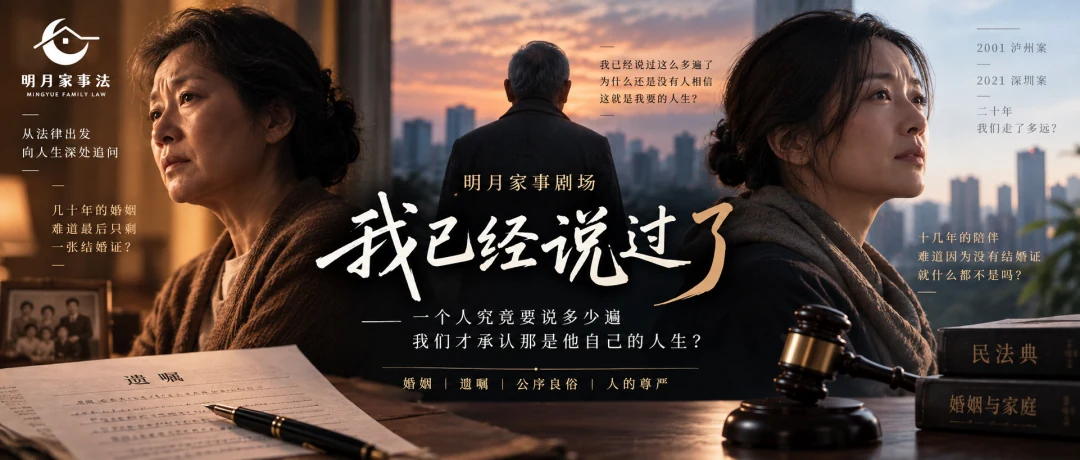
I Have Already Said It
How many times must someone speak before we accept that this is his life? Marriage creates responsibilities. Does responsibility mean losing the right to choose one’s life anew?
Mingyue Gao’s note: Luzhou, Sichuan, 2001. A married man had lived for years with another woman. Before dying, he made a notarised will leaving her some property. The will and notarisation were genuine. Yet the court did not uphold the bequest. The case became a landmark in Chinese civil-law debate over testamentary freedom and public order and good morals, commonly known as the “Luzhou mistress bequest case”.
Twenty years later, Shenzhen. A familiar story: a man with a wife, five children and a decades-long marriage lived with another woman in old age. His first divorce action failed. He sued again, and this time the trial court granted a divorce. His wife appealed. Before the appeal ended, he died.
Meanwhile, he had made two wills seeking to leave property to the woman who accompanied his later years. Litigation followed his death. The first-instance court partly upheld the will; on appeal, that decision was reversed. The bequest was invalid.
The reasons again invoked the phrase heard twenty years earlier: public order and good morals.
But comparing Luzhou and Shenzhen may leave out a third question: even if a bequest is invalid, must years of substantial care by someone also count for nothing in law?
The law already offered another door. Article 14 of the former Inheritance Law, and now Article 1131 of the Civil Code, allow an appropriate share of an estate to a non-heir who provided substantial support to the deceased.
So this story has more than two possible answers.
Characters
Liu Yuanchuan — In his seventies, married with five children. After his marriage deteriorated in later life, he brought two divorce actions.
Chen Suqin — His wife, who shared decades of life with him and raised their five children.
Yang Lan — Initially entered his life as a carer, then lived with him for years.
Mingyue Gao — An experienced family lawyer, introduced to Liu after his first divorce action failed, later involved in his marital, property and testamentary planning.
Lawyer Zhu — An assistant lawyer on Mingyue Gao’s team.
Act I: The Marriage Remains; the Person Has Left
Rain outside the office. An older man sits at the desk.
Between us lies a judgment that has just taken effect: divorce refused.
Liu: The court wouldn’t allow it.
Gao: Why do you still want to divorce?
Liu: Because this marriage ended long ago.
Gao: When?
Liu pauses: Ten years ago. Perhaps earlier.
Gao: You mean the feelings. I mean the marriage.
Liu: Is there a difference?
Gao: Of course. Feelings can begin with two people and end with one. Marriage is different. While the legal relationship remains, it continues to create rights and duties.
Silence. Liu: But I no longer want this life.
Gao: For now, I won’t ask whom you love. Do you want to leave a woman, or end a life that no longer belongs to you?
A long pause.
Liu: The latter.
Act II: How Much of “Mine” Is Mine?
Months later, Liu returns.
This time he brings an asset list.
Liu: I want a will. These properties are for Yang Lan.
Gao does not reach for a pen: No.
Liu is surprised: I cannot decide who receives my own properties?
Gao: There is a dangerous word in what you just said.
Liu: Which?
Gao: “My.”
Gao pushes back the list.
Gao: The first question in planning a will is never “Who should receive it?”
It is: which of these assets actually belong to you?
Liu: What do you mean?
Gao: If they are marital property, your wife has rights in them. No longer loving her is an emotional fact. Seeking divorce is your freedom. But the end of love does not erase another person’s acquired property rights.
Liu says nothing.
Gao: Marriage cannot force you to keep loving someone. Nor does love ending automatically extinguish the property responsibilities marriage has created.
Liu: What about the part that belongs to me?
Gao looks at him.
Gao: That is another question.
Act III: I Have Already Said It
Night. Two people remain in the office, an unfinished will on the desk.
Gao: A few more questions, Mr Liu.
Liu: Go ahead.
Gao: Without Yang Lan, would you still divorce?
Liu: Yes.
Gao: Without these properties, would you still live with her?
Liu: Yes.
Gao: If a court later held this will contrary to public order and good morals, would you still want to make it?
He looks at the paper.
Liu: Yes.
Gao: Why?
Liu pauses.
Liu: Because I have already said it. I sued for divorce, was refused, waited, then sued again.
Once was not enough, so I said it twice.
He points to the will: The same here. If one is not enough, I’ll write another. He looks up: How many times must I say it before you believe this is the life I want?
Gao remains silent for a long time.
Then picks up the pen.
Act IV: Her Decade and My Decades
Liu dies. The divorce proceedings end upon his death. Legally, he remained Chen Suqin’s husband until the end.
Soon afterwards, Chen visits the office for the first time.
Chen: You helped plan the will?
Gao: Yes.
Chen: Are you married?
Gao: Yes.
Chen: If your wife lived with another man for years and left him everything you had earned together over decades, could you sit here talking about testamentary freedom?
Gao does not answer.
Chen: You keep saying she spent over a decade with him. Fine. What about me? We were married for decades, raised five children and built this family from nothing. I admit things went wrong. I know he stopped loving me. But if her years were real, were mine imaginary?
She sits: Why are her years called love, while all my decades leave is a marriage certificate?
Silence.
Gao: It would be arrogant to tell you that your pain has no legal significance.
Chen watches him.
Gao: But rewriting another adult’s final, repeated and clearly expressed wishes because of your pain might be another kind of arrogance.
Act V: The Person Without a Title
Days later, Yang Lan sits in the same chair.
Yang: He left this to me.
Gao: Not entirely.
Yang: What do you mean?
Gao: He could not dispose of Chen’s share of marital property.
Yang: But he made the will himself.
Gao: That is why I know its limits. Respecting his wishes does not mean satisfying all your interests.
Yang falls silent.
Then: Do you know how many years I spent with him?
Gao: Yes.
Yang: His meals, his medicines—I saw to them. Illness, hospital stays—I was there. Sleepless nights—I talked with him. I never asked anyone to call me Mrs Liu. I knew I wasn’t.
She looks up: But without that certificate, did all those years never happen?
Gao is silent.
Yang: I don’t want her property. Give her what is hers. But what about what was his?
Gao: That is the hardest part. Law can measure a property’s floor area. Years of companionship are harder to measure.
Yang smiles bitterly.
Gao: Being unmeasurable does not mean nonexistent. But existence does not automatically turn companionship into a property right.
She lowers her head.
Yang: What about the years I cared for him?
For the first time, Gao has no immediate answer.
Act VI: Twenty Years Earlier
Late at night, the team prepares the appeal.
Zhu looks up: Mr Gao, I found a case.
Gao: Which?
Zhu: Luzhou, 2001. Huang Yongbin was married and later lived for years with Zhang Xueying. He made a will before dying and had it notarised. The court accepted that it reflected his genuine wishes. But in the end…
Gao: What happened?
Zhu: The bequest was not upheld.
Gao: Why?
Zhu: Public order and good morals.
Silence. Gao takes the old judgment, reads page after page, then stops.
Gao: His wife still cared for him in hospital after his cancer became advanced?
Zhu: The judgment says so.
Gao nods and lays the files side by side: 2001, Luzhou; 2021, Shenzhen.
Gao: Similar.
Zhu: So very bad for our case.
Gao: No.
Zhu: Why?
Gao: Before looking for similarities, find the differences. Did Huang sue for divorce?
Zhu: I found no reference in the public material.
Gao: Had a court already granted a divorce?
Zhu: No.
Gao: And this man?
Zhu opens the Shenzhen file: First action refused. Second action granted at first instance. His wife appealed; he died during the appeal.
Gao: The wills?
Zhu: Two.
Zhu pauses: So we tell the court Luzhou was wrong?
Gao closes the old judgment: No. Tell the court this case is not Luzhou.
Zhu is silent.
Then: But that is how the court ruled twenty years ago.
Gao looks at the yellowed judgment.
Gao: Precedents deserve respect. But if law only repeats twenty-year-old answers, why do we need twenty years to pass?
Zhu remembers something: There is another provision.
Gao: What?
Zhu: An appropriate estate share may be given to a non-heir who provided substantial support to the deceased.
Both fall silent.
After a while:
Gao: So the law gave us a third answer long ago.
Act VII: A Third Answer
The appeal hearing.
Gao rises: Presiding Judge, I would separate this case into three questions.
First: could Liu dispose of his wife’s share of marital property? No. Her share must be fully protected.
Second: could he dispose of the estate genuinely his own? In principle, that is the question of testamentary freedom.
Third: if the court concludes that these bequests are invalid on public-order grounds because of the beneficiary’s identity and their relationship, must Yang’s years of care count for nothing too?
The courtroom quietens.
Gao: Luzhou also involved a lawful spouse, an extramarital cohabitant, a genuine will and public order and good morals. I do not seek to judge that decision today. Cases matter not only for what they share, but for the differences they force us to find.
He lifts the file: Liu sued for divorce, was refused, and sued again. A trial court granted it; his wife appealed; he died before the appeal ended. Meanwhile, one will, then another; one expression, then another. This adds a question: how, and how often, must an adult express a choice before law will recognise it as his genuine choice of life?
He pauses and takes another sheet.
Gao: I also ask the court to consider Article 14 of the former Inheritance Law and Article 1131 of today’s Civil Code: a non-heir providing substantial support may receive an appropriate estate share. Yang was not his wife and has no spousal status or statutory inheritance entitlement. That is undisputed. But must law assess only identity, never conduct?
If evidence establishes that she managed daily care, accompanied his ageing and nursed him through illness for years, might the law recognise those acts even if it rejects the bequest?
That would not make her his wife, grant marital status to an extramarital relationship, or give her Chen’s property. It asks a different question: should sustained care itself be evaluated? Marriage is a status; support and care are conduct. A status or relationship may attract legal disapproval. Must that also negate genuine acts of kindness within it?
No one speaks.
Gao: I understand protecting marital fidelity through public order and good morals. But Article 1131 also reflects values law should encourage: supporting older people, nursing the sick, not abandoning someone as they age. Two ethical values stand here—fidelity and long-term care. We may restrict some dispositions for the former. Must we declare the latter worth zero?
Act VIII: Three Forms of Justice
After the adjournment, Chen and Yang sit far apart in the corridor without speaking.
Gao stands at the window. Zhu approaches.
Zhu: Who do you think should win?
Gao, without turning: That is the wrong question.
Zhu: Why?
Gao looks towards Chen: They stand for different things. She represents the justice of commitment: decades of marriage, five children, shared assets, time and responsibility cannot disappear because someone later changes his life. Looking towards Yang: She represents the justice of lived experience. No marital status does not mean companionship and care never happened. Looking at the wills, quietly: The deceased represents the justice of autonomy. Does an adult who once married still have the possibility of choosing a different life?
Zhu: What can law do?
Gao: The hardest cases are not justice against evil. They are three reasoned forms of justice that cannot all be satisfied together.
Epilogue
The appeal judgment arrives. The earlier ruling is reversed; the bequest is held invalid.
That evening Yang returns. Two wills lie on the desk beside the old Luzhou judgment.
Yang: What was the point of his writing these?
Gao does not answer.
Yang: Were we wrong?
Gao: The judgment resolved the case.
Yang: What remains unresolved?
Gao: Two divorce actions. Two wills. Years of cohabitation. Decades of marriage. A dead man who can no longer explain himself. Three questions remain.
Yang: Which?
Gao: How far marriage should be protected. How far an adult may decide his life. And whether law will recognise what a person genuinely did to care for him, even without a formal status.
She is silent.
Then: What about him?
Gao looks at the wills and says softly: How many times must someone speak before we acknowledge that this is his own life?
Lights fade.
Beyond the Theatre: From Luzhou to Shenzhen—Can We Find a Third Answer Twenty Years Later?
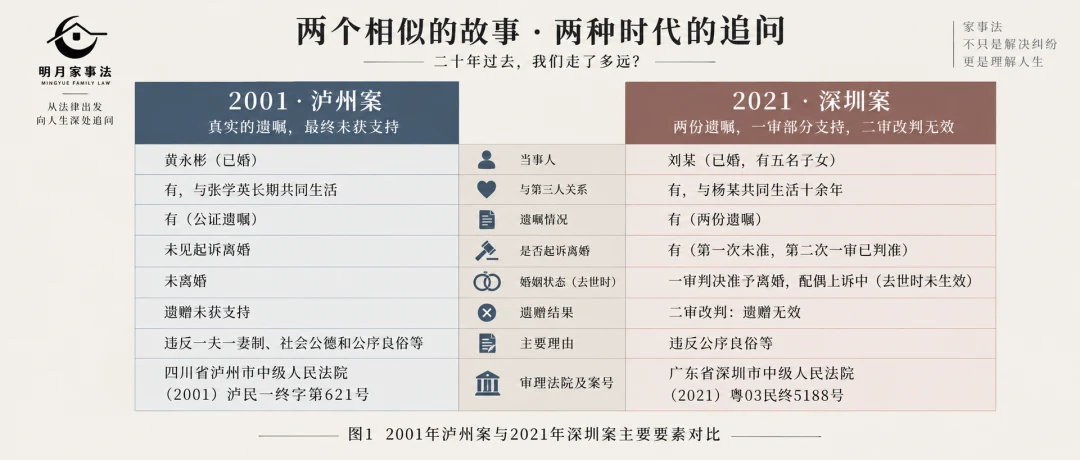
| Issue | Luzhou, 2001 | Shenzhen, 2021 |
|---|---|---|
| Testator | Mr Huang, married | Mr Liu, married with five children |
| Extramarital relationship | Long-term cohabitation with Zhang Xueying | More than ten years living with Ms Yang |
| Bequest | Yes, notarised | Yes, two wills |
| Divorce proceedings | No action located | First action refused; second granted at first instance |
| Status at death | Not divorced | Divorce decree under appeal; not effective at death |
| Bequest outcome | Not upheld | Reversed on appeal; bequest invalid |
| Principal grounds | Monogamy, social morality, public order and good morals | Public order and good morals |
| Court and case reference | Luzhou Intermediate People’s Court, Sichuan (2001) 泸民一终字第621号 | Shenzhen Intermediate People’s Court, Guangdong (2021) 粤03民终5188号 |
The two cases are strikingly similar: lawful wives, extramarital cohabitants, genuine wills, marital property, public order and bequests ultimately unfulfilled. Yet seeing only “wife” and “third party” may obscure family law’s hardest questions. At least three distinct issues must be separated.
First, a spouse’s property cannot be taken away by a will
This is about property rights. One may decide the disposition of one’s own estate, not treat the other spouse’s share as one’s own. Whether a marriage is emotionally over, acquired spousal property rights must be protected. That is the baseline.
Second, does legal disapproval of an extramarital relationship necessarily negate freedom to dispose of one’s own estate?
This concerns public order and testamentary freedom, the source of continuing debate over Luzhou. Shenzhen adds a particular fact: the testator did not merely say the marriage was over. He brought successive divorce proceedings, even obtaining a first-instance decree. The marriage remained legally intact because his wife appealed and he died during the appeal. He also made two wills. When legal status conflicts with an adult’s sustained and repeated choices, how far should the state intervene?
Third, even if the bequest is invalid, must long-term care count for nothing?
This is easily overlooked. Article 1131 permits an appropriate share to a non-heir who substantially supported the deceased. The Civil Code did not invent this: Article 14 of the former Inheritance Law already made essentially the same provision when these cases arose. In the publicly available judgments located, neither court separately awarded the cohabitant an appropriate share under that rule.
Restraint is necessary. In Shenzhen, the claim of years of care came mainly from Ms Yang’s submissions; duration, extent and contribution require proof. The public judgment also shows that her claim was chiefly based on the bequest. Available material does not sufficiently establish an independent alternative claim under Article 14. We cannot simply say the court “overlooked” that provision. Nevertheless, the distinction between evaluating status and evaluating conduct is instructive. Someone may lack spousal status; a relationship may attract marital-law disapproval. Must those assessments be inseparable from conduct? Could law say: you are not the wife, and this relationship is not endorsed as marriage; yet if you genuinely provided sustained care, I will assess those acts rather than reward your status?
That is the insight offered by Article 1131. It asks first what someone did, rather than who they were. This creates tension within public order and good morals itself. Fidelity is a social value; care for older people, support and mutual help are also social values. When both arise around one person, can we disapprove a relationship’s status yet acknowledge genuine care within it?
This need not concede ground to extramarital relationships. It may instead permit finer analysis: the wife retains her property; a will disposes only of the testator’s property; public-order validity is assessed separately; eligibility for an appropriate share through care is assessed separately again. We need not force every question into a “good person” or “bad person” label. Commitment, lived experience and autonomy collide. The case is no longer merely which woman deserves sympathy.
The justice of commitment: established marriage, property and responsibility cannot lightly be erased by today’s choices.
The justice of lived experience: real companionship, support and care outside formal status should not automatically become nothing because of a label.
The justice of autonomy: having married does not mean forever losing the right to choose a different life.
The tragedy is that all three have reasons, yet cannot always be realised together.
Mingyue Gao’s Afterword
The longer I practise, the less I favour deciding who is “good” first, then allocating rights. Families rarely contain pure heroes and villains. More often, people bring different legitimate reasons to court. The wife asks why a later arrival should erase her decades. The companion asks why real care counts for nothing without a certificate. The deceased might ask why others ultimately decide his life after he repeatedly expressed his choice.
Law’s hardest task should not be a moral ranking, but separating rights and protecting each: the wife’s property; the deceased’s testamentary freedom within legal limits; and a third party’s proven support and care under the relevant rules. Perhaps that is a modest step beyond Luzhou twenty years later—not simply declaring winners and losers, but recognising that a complex life may require more than one legal answer.
I increasingly think family law matures not when it can give every family a standard answer, but when it can accommodate lives that do not fit a standard pattern.
Mingyue Family Theatre
Starting from law, asking deeper questions about life