English translation of the Chinese original. Original illustrations are retained, including text within images. Translation and web presentation: 7 October 2026.
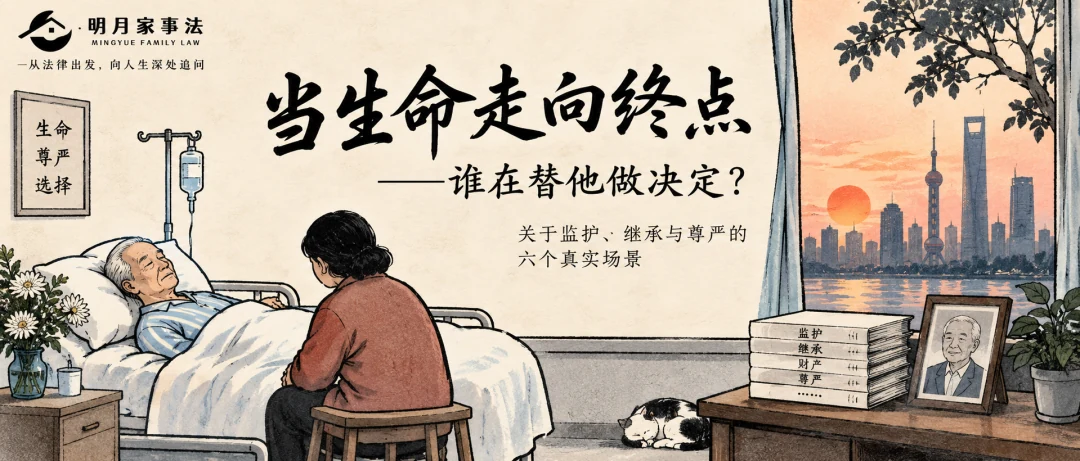
A note from Mingyue Gao
This is a true story I learned of today. Its legal background is not complicated, yet it reveals a tension within our institutions that deserves reflection.
Under Articles 1127 and 1128 of the PRC Civil Code, in the absence of a will or other relevant arrangements, siblings are in the second order of statutory succession. Where a sibling predeceases the deceased, that sibling’s children may inherit by representation. The nieces and nephews in this story might therefore inherit by representation after the older man’s death, if the statutory conditions are met.
A possible inheritance, however, does not automatically entail guardianship duties. Under Article 28, statutory guardians for an adult with no or limited civil capacity include, in order, a spouse, parents and children, and other close relatives, among others. Nieces and nephews do not automatically qualify as guardians simply because they might inherit by representation.
Where no person legally qualifies to act as guardian, Article 32 provides for a qualifying residents’ committee, villagers’ committee or civil affairs department to act. This produces a particular legal structure:
Those responsible for the older person’s guardianship today may not receive his estate tomorrow; those who might share his estate may have no responsibility for his guardianship today.
When someone is still alive but others already view his property as a future inheritance, genuine conflicts can arise between guardianship, inheritance and human dignity.
That is where this story begins.
When an Older Person Falls Silent, Who Speaks for Him?
A modern tragedy of guardianship, inheritance and death
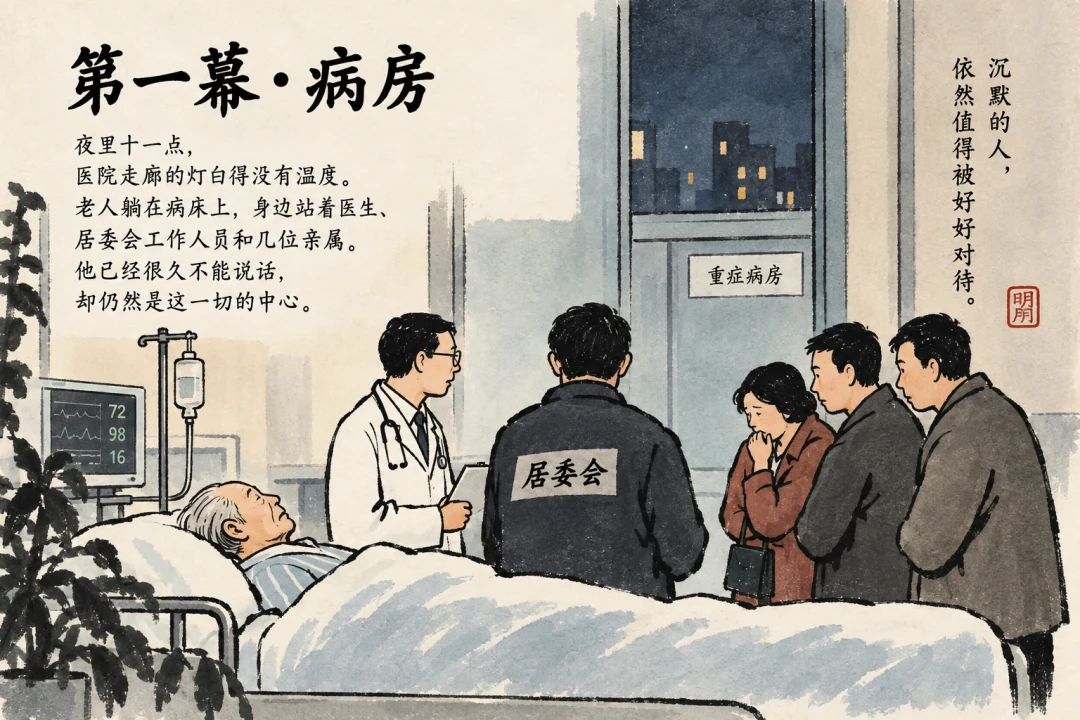
Act I: The Hospital Room
Eleven at night.
The hospital corridor glows with a cold white light.
An older man lies in intensive care.
When he first entered the world more than seventy years ago, it was probably much like this: unable to speak or walk, with every decision about him made by others.
Back then, his parents stood around him.
Now there are doctors, a residents’ committee worker, and a few relatives who seldom visit.
He has been living with dementia for a long time.
He has no wife or children. His parents and siblings have all died.
He owns a home and has savings.
What he does not have is someone who can say for him now:
“This is the life he wanted.”
A doctor comes out.
“His condition is poor.”
“We need to decide whether to continue active treatment.”
The corridor falls silent.
The doctor looks at the committee worker.
Legally, he is the man’s guardian.
More precisely, not “he”.
The organisation behind him: the residents’ committee.
With no suitable statutory guardian available, the committee assumed public guardianship duties after the man lost capacity.
The worker looks down at the papers in his hand.
He knows he should make the decision for the older man.
But he also knows that several people stand at the other end of the corridor.
They are the children of the man’s deceased siblings.
They are not his guardians.
Not tonight, at least.
Yet after his death, if there is no will and the statutory conditions are met, they may inherit by representation.
So fate has arranged a revealing encounter in this hospital corridor:
The person responsible for his present stands beside those who might receive his estate in the future.
The man himself lies behind the door.
Silent.
Act II: Money
“How much more will it cost?”
Someone finally asks.
The doctor gives a figure.
No one responds immediately.
Someone else asks:
“Is there any point in continuing?”
It is an entirely reasonable question.
Medicine should certainly consider whether treatment is meaningful.
But then another voice adds:
“He’s already in this state. Spending so much more…”
The sentence trails off.
Sometimes the most important words are those that need not be spoken.
Everyone understands the missing half.
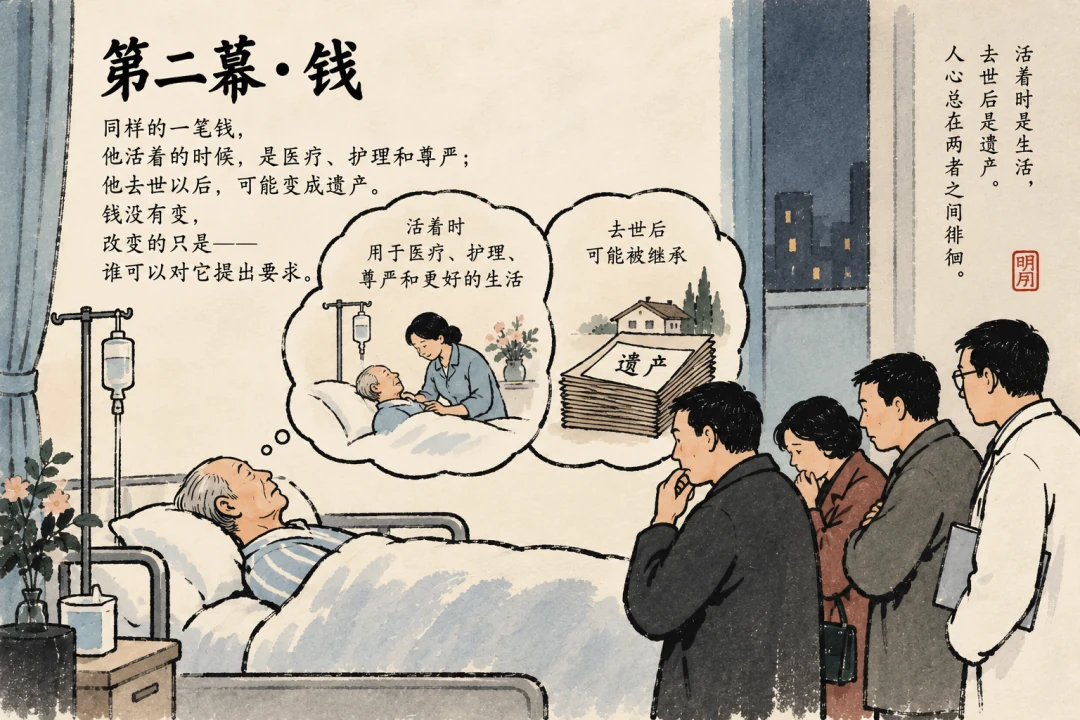
The older man has property of his own.
If treatment continues, that money will become an ICU bed, medicines, equipment, nursing care and bill after bill.
Once it leaves his bank account, it is gone.
But what if it is not spent?
It will not disappear.
It will remain.
Once someone stops breathing, what was called “savings” during his lifetime suddenly acquires another name.
An estate.
A curious change of vocabulary.
The same one million yuan.
While he lives, it can buy care, treatment, dignity and time.
After he dies, it can be inherited.
The money has not changed.
Only who can lay claim to it has changed.
Act III: The Guardian
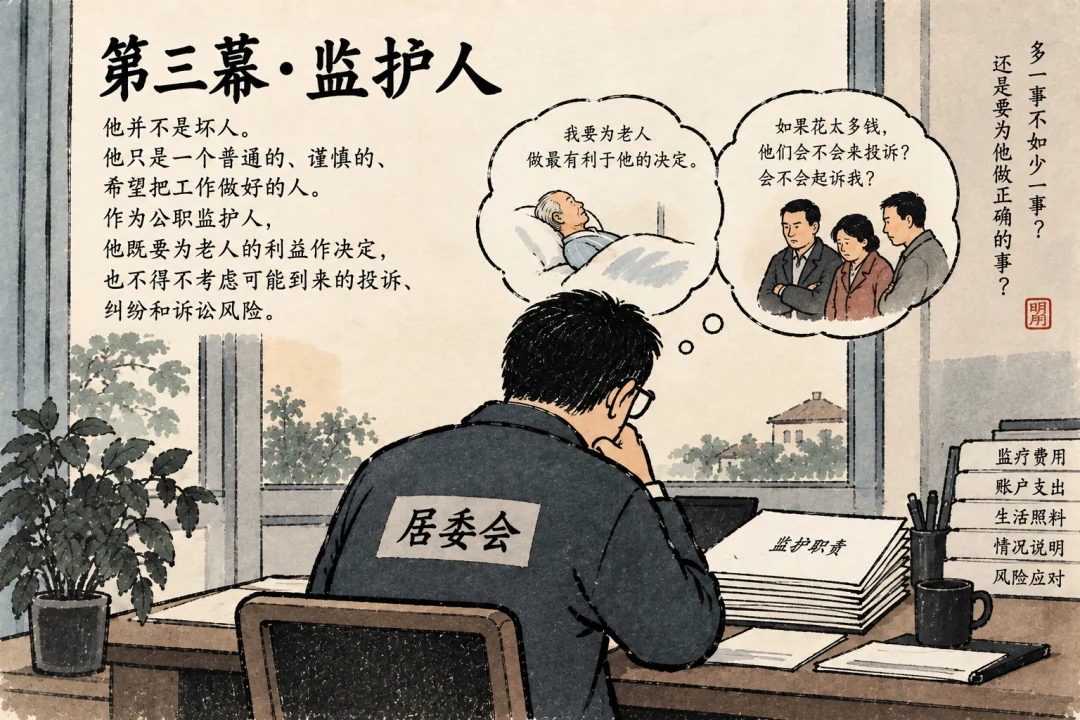
The committee worker says nothing.
He is not a bad person.
Indeed, matters are harder precisely because he is an ordinary, cautious person who wants to do his job well.
What if he decides to continue treatment?
The bank balance will keep falling.
Will the relatives complain?
Will they accuse the committee of wasting the man’s money?
Will they demand to inspect the accounts?
Will they make a scene at the subdistrict office?
Will they sue?
Years later, after the man has died, will they arrive with a pile of bills and ask:
“What right did you have to spend so much?”
But what if treatment does not continue?
Everything seems much simpler.
No new enormous bills.
No lengthy explanations.
No one demanding to know why his money was spent.
For a frontline community worker, this is a cruel and practical choice.
On one side, an older man who can no longer express his views.
On the other, people who can speak, complain, challenge and perhaps sue.
Shakespeare had Hamlet ask:
“To be, or not to be?”
Tonight, that question takes a more mundane, more modern form:
“To treat, or not to treat?”
Only the person deciding is not the person in the bed.
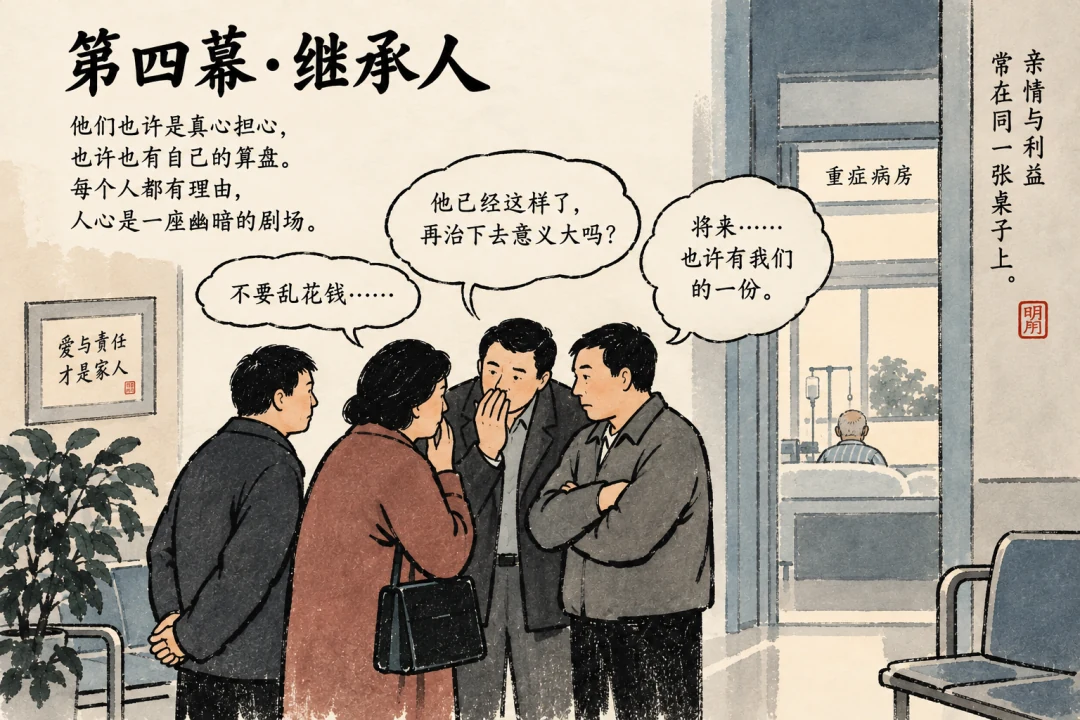
Act IV: The Heirs
Nor should we rush to blame the relatives.
They might say:
“We’re only worried someone will misappropriate his property.”
“Of course a guardian needs oversight.”
“Does being his guardian mean you can spend his money however you like?”
Every statement sounds reasonable.
They may even sincerely believe they are protecting him.
But the human heart is a dimly lit theatre.
Behind “protecting our uncle’s property”, there may be another, less speakable thought:
“One day, some of it may be mine.”
This does not mean they want him to die.
Still less should we infer bad faith merely because someone might inherit.
The problem is more complicated than good and evil.
What is truly unsettling is this:
The law has seated interests that do not entirely coincide at the same table.
The older man would want his property to serve his own needs.
The guardian wants to fulfil his duties, but also to avoid risk.
The relatives want the guardian not to harm the man’s interests, while possibly hoping for a share of whatever remains after his death.
The doctor simply wants to know:
“Who is going to decide, now?”
Everyone has reasons.
Everyone has fears.
Everyone, perhaps, has calculations of their own.
Only one person has none.
The person to whom the money actually belongs.
Because he can no longer speak.
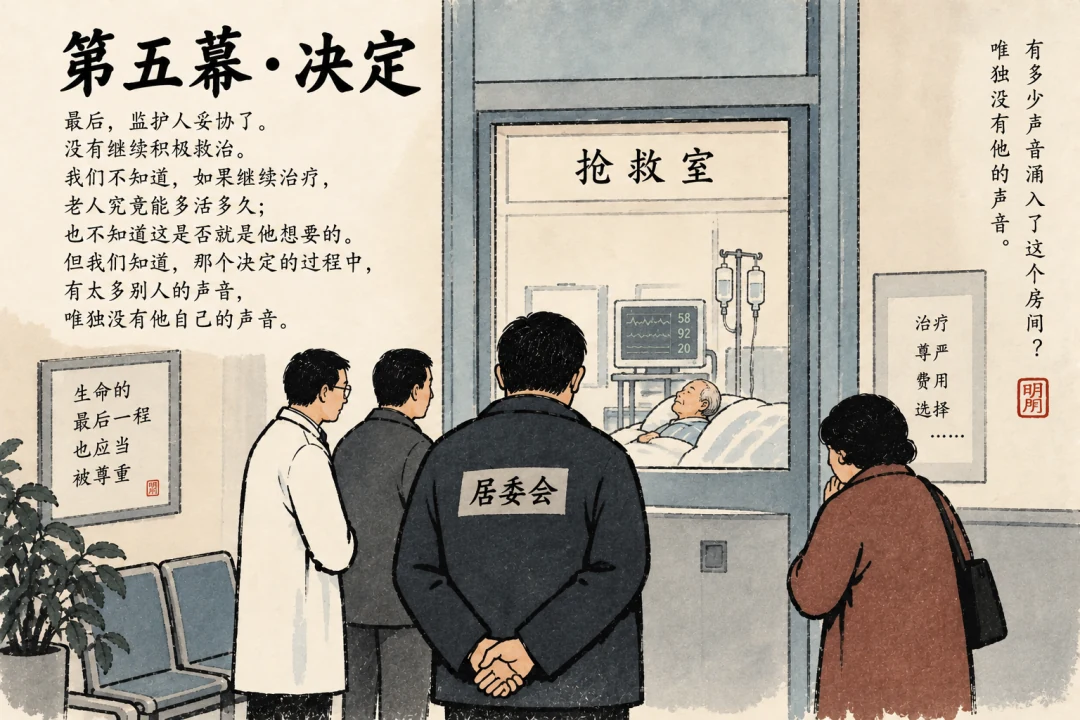
Act V: The Decision
In the end, the guardian compromises.
Active treatment does not continue.
We do not know how much longer treatment might have kept the man alive.
Nor whether it would have meant recovery, suffering or merely a prolonged dying process.
So no one can casually declare:
Continuing life-saving treatment was necessarily right.
Nor can anyone say, solely from the outcome:
Stopping treatment was necessarily wrong.
What we should question is something else:
Which voices entered the room as that decision was made?
The doctor’s voice entered.
The relatives’ voices entered.
The guardian’s concerns entered.
The shadows of complaints, litigation and liability entered too.
Even a “future estate” that did not yet exist seemed to enter the hospital room early.
But—
Where was the older man’s voice?
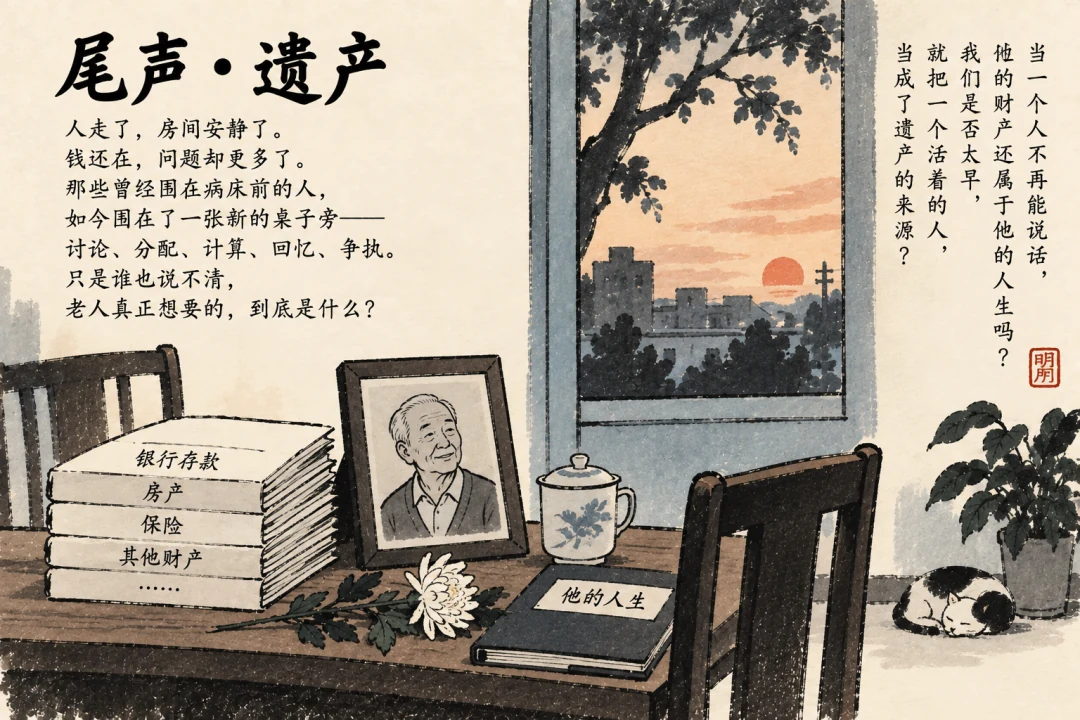
Epilogue: The Estate
What might have happened if he had not developed dementia?
Perhaps he would have said: “I earned this money. Use it to treat me.”
Perhaps: “Enough. I don’t want to spend my last days in intensive care.”
Perhaps: “It doesn’t matter if every penny is spent.”
Perhaps: “Leave a little for my nieces and nephews.”
We do not know.
That is the saddest part of this tragedy.
We know how much is in his bank account.
We know who might inherit.
We know who his guardian is.
We know which provisions govern statutory succession, inheritance by representation and guardianship duties.
Yet we do not know the one thing that matters: how he himself wanted to spend the last part of his life.
The law calls the property remaining after death an estate.
It is an ordinary legal concept.
But this story makes me ask another question: while someone is still alive, have we already begun, too early, to treat his money as an “estate”?
If so, something very strange has happened: those who may inherit tomorrow are not responsible for his care today; those responsible today must nevertheless worry about those possible future heirs.
A succession that has not yet occurred begins to shape guardianship that is happening now. An estate not yet formed begins to shape a living person’s life.
One day it may even stand beside the hospital bed and take part in decisions about life itself.
And the person who accumulated that wealth over a lifetime lies there,
as quietly as someone who has nothing to do with any of it.
Before the curtain falls, I want to leave a few questions:
While a person is alive, whose life should his money serve first?
Should those who might inherit in the future have power to influence guardianship decisions today?
How should we understand oversight when the overseers may themselves share the property that remains?
If fear of future heirs’ complaints and lawsuits leads a guardian to change a decision originally based on the person’s interests, whom has the law protected?
And one final question:
If we someday lose the ability to express ourselves—
Who can ensure that those speaking for us will still speak in our voice?
End

Beijing Guantao Law Firm, Shanghai Office
Address: 22F, L’Avenue, 99 Xianxia Road, Shanghai 200336, China
Add: 22F, L'Avenue, No.99 Xianxia Rd, Shanghai, PRC
Tel: +86 21 23563298
Fax: +86 21 23563299
Email: gaomy@guantao.com